
You have washed your favourite shawl and suddenly it looks shorter, narrower or less fluid than before. The borders may appear wavy, the embroidery may be puckered, or the fabric may feel thicker. Naturally, you begin wondering: does Pashmina shrink?
Yes, Pashmina can shrink when it is exposed to hot water, sudden temperature changes, vigorous rubbing, machine agitation, wringing or heated drying. Mild shrinkage may sometimes be improved with cool water and gentle reshaping. However, a severely felted shawl usually cannot be returned fully to its original size and softness.
Heat, moisture and mechanical action can cause the surface scales of animal fibres to interlock, producing felting and potentially irreversible shrinkage. (Woolmark)g part is that most shrinkage is preventable. This guide explains what causes the problem, how to identify the damage, how to unshrink Pashmina safely when the change is mild, and when to stop home treatment.
Quick Answer: Does Pashmina Shrink?
Does Pashmina shrink when washed? It can, although water alone is not always the main problem. Shrinkage usually occurs when moisture is combined with heat, friction, agitation or incorrect drying. A wet shawl may also lose its shape if it is wrung, stretched or hung from a clothesline.
Here is a quick diagnosis before you try to rescue a shrunken Pashmina shawl:
| Problem | Likely cause | Home action | Professional help |
|---|---|---|---|
| Slightly smaller | Warm water or minor contraction | Cool-water relaxation and gentle reshaping | Usually unnecessary |
| Wavy edges | Uneven drying or border tension | Reshape and dry flat | Sometimes |
| Thick and stiff | Felting from heat, rubbing or agitation | Stop treatment; do not pull | Recommended |
| Distorted embroidery | Unequal tension in cloth and thread | Do not stretch or press aggressively | Recommended |
| Longer in one direction | Hanging while wet | Support flat and reshape gently | Sometimes |
| Colour bleeding | Unstable dye or unsuitable washing | Stop washing and blot carefully | Recommended |
Does Pashmina Shrink When Washed?
Many owners ask, does Pashmina shrink during hand washing? It can if the hand-washing method is rough. “Hand wash” does not mean scrubbing the shawl like a cotton dupatta, soaking it for several hours or squeezing it tightly.
Once wet, Pashmina becomes heavier and easier to distort. Rubbing can make surface fibres catch, a warm-to-cold rinse can encourage contraction, and wringing can pull the weave out of alignment.
Use cool water, very little wool-safe cleanser and minimal movement. Keep wash and rinse water at similar temperatures, and follow the care label. Embroidery, zari, silk blends or unstable dyes may require professional cleaning. Wool-care guidance consistently recommends following the individual garment’s care instructions rather than assuming that every animal-fibre item can be washed in the same way. (Woolmark)shmina shrink every time it is washed?** No. A correctly handled shawl should not automatically become smaller. The risk depends on its fibre content, weave, finish, age, embellishment and washing method.
Why Does Pashmina Shrink? Common Causes
To understand does Pashmina shrink, it helps to look at the five most common causes.
Does Pashmina Shrink in Hot Water?
Hot water increases the effect of fibre movement, rubbing and detergent, and may affect colour or finishing.
In Indian summers, water from an overhead tank can become surprisingly warm during the afternoon. Let it cool before washing an expensive shawl.
Never use a tumble dryer, room heater, hair dryer or hot iron to speed up the drying process.
Does Pashmina Shrink After a Sudden Temperature Change?
Moving Pashmina from warm water into a cold rinse can shock the fibres. Keep the wash water and rinse water at a similar cool temperature.
This is why the answer to does Pashmina shrink when washed is more complicated than simply saying that water causes shrinkage. Temperature stability and handling are equally important.
Friction, Rubbing and Scrubbing
Moisture, heat and friction can make the microscopic scales on animal fibres interlock. This process is known as felting.
Once the fibres become tightly matted, forceful stretching will not separate them. Pulling may instead tear, thin or permanently distort the shawl. (Woolmark) stain with:
- A laundry brush
- A toothbrush
- A rough sponge
- Another section of the shawl
- Concentrated detergent
Aggressive spot cleaning can also leave a pale ring, stiff patch or distorted section even when the rest of the shawl appears normal.
Does Pashmina Shrink in a Washing Machine?
A washing machine repeatedly turns, presses and rubs the shawl. Even a delicate or wool cycle may be unsuitable unless the manufacturer specifically permits machine washing.
Products sold as “Pashmina” may be pure or blended with wool, silk, viscose, acrylic or polyester. One shawl may survive a gentle machine cycle while another may become noticeably smaller and thicker.
Never assume that a wool setting is automatically safe. Check the sewn-in care label first.
Does Pashmina Shrink When It Is Wrung or Dried Incorrectly?
Twisting can tighten borders, distort the weave and create diagonal pulling. Hanging a wet Pashmina may stretch the centre or corners because water makes the fabric heavier.
Therefore, when someone asks does Pashmina shrink after washing, the apparent size change may sometimes be a combination of fibre contraction and shape distortion.
A shawl may look shorter because:
- The borders have tightened.
- The centre has stretched downwards.
- The fabric has dried unevenly.
- The embroidered section and plain fabric have contracted differently.
- The weave has shifted diagonally.
Does Pashmina Shrink or Felt? How to Tell the Difference
Before trying to learn how to unshrink Pashmina, check whether the shawl has mildly contracted or truly felted.
Signs of Mild Pashmina Shrinkage
A mildly shrunken Pashmina shawl may:
- Look slightly shorter or narrower.
- Remain soft, light and flexible.
- Retain its visible weave.
- Drape almost normally.
- Respond slightly when smoothed on a flat surface.
- Have wavy rather than heavily matted borders.
In this situation, the answer to does Pashmina shrink permanently may be no. You may be able to recover part of the lost shape through controlled relaxation and reshaping.
Signs of a Felted Pashmina Shawl
A felted shawl may:
- Feel thick, stiff or board-like.
- Look denser and less transparent.
- Have a fuzzy or matted surface.
- Lose its original fluid drape.
- Show severe or uneven size loss.
- Resist gentle reshaping.
- Develop puckered borders and motifs.
- Feel much heavier than before.
When readers ask does Pashmina shrink beyond repair, they are usually describing felting.
Felting is more serious than temporary tightening because the fibres have mechanically locked together. Wool-care guidance notes that recovery may not be possible after a hand-wash-only or dry-clean-only item has been severely felted in a washing machine. (Woolmark)ina Shrink Permanently? Restoration Limits
Sometimes, but expectations should remain realistic.
If the shawl is only slightly smaller and still feels soft, it may be possible to relax the fibres and recover some of its original dimensions.
If it has become heavily felted, no home method can reliably restore its original weave, size and drape.
Before attempting a rescue, confirm:
- The fibre composition
- The care instructions
- The colourfastness
- The presence of sozni, kani, zari or beadwork
- Whether the fabric remains soft
- Whether the damage is even
- Whether there are holes or weak sections
For an heirloom or embroidered shawl, professional assessment is safer.
The question is not only does Pashmina shrink, but whether further wetting could worsen the damage.
How to Unshrink Pashmina: Gentle Steps for Mild Damage
Use this method only for a slightly shrunken Pashmina shawl that remains soft, colourfast and structurally sound.
Stop immediately if:
- The dye runs.
- The fabric becomes stiffer.
- The embroidery begins pulling.
- The border starts curling.
- The shawl develops a matted surface.
Step 1: Measure the Dry Shawl
Lay the shawl flat and note its current length and width.
Take photographs of:
- The borders
- The corners
- The embroidery
- Any distorted sections
These measurements give you a reference and help prevent over-stretching.
Do not rely only on your memory of the original size. A shawl may have changed in one direction more than the other.
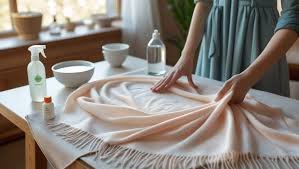
Step 2: Prepare Cool Water
Fill a clean basin with cool water.
If the shawl contains detergent residue, add only a small quantity of wool-safe cleanser. If it is already clean, plain cool water may be enough to relax it.
Do not add:
- Hot water
- Bleach
- Strong detergent
- Stain remover
- Fabric softener
- Whitening liquid
- Disinfectant
- Baking soda
Test the colour in a hidden corner before wetting the complete shawl.
Step 3: Wet It Without Agitation
Lower the shawl into the water without bunching it.
Press it gently beneath the surface. Do not rub, knead, twist or repeatedly lift it.
Keep the soak brief. A longer soak does not automatically produce better restoration and may increase the risk of colour bleeding or distortion.
Step 4: Lift It With Full Support
Support the entire shawl with both hands or slide it onto a clean towel.
Never lift saturated Pashmina from one corner. The weight of the absorbed water can stretch the weave or pull an embroidered section.
Step 5: Blot With Towels
Lay the shawl on a clean, colourfast towel.
Roll the towel loosely and press to remove excess water. Do not twist or wring the roll.
Repeat with another dry towel when necessary.
Step 6: Reshape It Gradually
Place the damp shawl on a dry towel or supported mesh surface.
Smooth it gently from the centre towards the edges. Alternate between length and width instead of pulling only the corners.
Compare it with your measurements and stop if the weave or embroidery appears strained.
The objective is to restore a balanced shape—not to force the shawl back to an exact measurement in one attempt.
Step 7: Dry It Flat
Allow the shawl to dry naturally at room temperature, away from direct sunlight, heaters and hot air.
Make tiny corrections while it remains damp, but do not continue stretching as it dries.
Drying delicate animal-fibre garments flat and away from direct heat helps prevent further distortion. (Woolmark)afest home answer to how to unshrink Pashmina. It may improve mild shrinkage, but it cannot reverse serious felting.
Can Conditioner Unshrink Pashmina?
Hair conditioner is frequently recommended online because it can make fibres feel softer or more slippery.
However, conditioner cannot unlock heavily felted fibres or guarantee lasting recovery. It may also:
- Leave an oily residue.
- Alter the surface finish.
- Affect delicate dyes.
- Add a strong fragrance.
- Attract dust.
- Complicate later professional treatment.
Avoid improvised conditioner treatments on pure, valuable or embroidered shawls. A suitable wool cleanser or professional advice is safer.
So, does Pashmina shrink less after a conditioner soak? Not necessarily.
Conditioner may temporarily change the feel of the fibres, but it does not remove the damage created by heat, friction and agitation.
When Not to Attempt Home Restoration
Do not attempt home restoration when:
- The shawl is thick, hard or heavily matted.
- Colours are bleeding.
- The fabric includes zari, sequins, beads or delicate embroidery.
- The embroidery is already puckered.
- The shawl is antique, signed, rare or highly valuable.
- There are holes, weak areas or moth damage.
- The fibre content is unknown.
- The label says “dry clean only”.
- The shawl has shrunk dramatically in both directions.
- A previous home treatment has already failed.
Textile-conservation guidance is particularly cautious about wet-cleaning wool, silk and items with trims, beads, sequins or structural components that may react differently to moisture. (Canada)king does Pashmina shrink permanently and the shawl is dense and stiff, stop soaking and pulling.
A specialist may improve its finish or usability, but repeated home treatment can worsen the damage.
Does Pashmina Shrink During Drying? Safe Drying Method
Correct drying is essential for Pashmina care after washing.
Even a gently washed shawl can become distorted if it is hung, pressed or exposed to high heat while wet.
Dry the Shawl Flat
Place it on:
- A clean towel
- A fully supported drying rack
- A flat mesh surface
- A clean cotton sheet
Arrange the edges straight and keep the weave relaxed.
Do not place the wet shawl directly on a rough floor, coloured bedsheet or newspaper.
Never Hang It While Wet
Does hanging a wet Pashmina change its shape? Yes.
The added water weight can:
- Lengthen the centre.
- Pull the corners.
- Distort the fringe.
- Create marks from a hanger.
- Tighten embroidered sections.
- Produce an uneven hemline.
A wet Pashmina should be treated as a supported textile rather than an ordinary dupatta.
Avoid Direct Sunlight and Heat
Strong Indian sunlight may fade colours and dry the edges faster than the centre.
Keep the shawl away from:
- Balcony or terrace sunlight
- Room heaters
- Geyser pipes
- Radiators
- Hair dryers
- Hot irons
- Tumble dryers
Dry it in a shaded, ventilated room.
Move It Only With Support
If the towel underneath becomes wet, roll or slide the shawl onto another towel. Do not pick it up from one end.
If you follow these rules, the question does Pashmina shrink during drying becomes much less worrying.
Does Pashmina Shrink During Dry Cleaning?
Professional dry cleaning is commonly recommended for delicate Pashmina, especially when the care label says “dry clean only”.
However, dry cleaning is not automatically risk-free.
A shawl may return smaller, stiffer or distorted after:
- Unsuitable processing
- Excessive mechanical action
- Poor stain treatment
- Aggressive finishing
- High-temperature pressing
- Incorrect handling of embroidery
Choose a cleaner who has experience with pure Pashmina and Kashmiri embroidered shawls—not merely ordinary winter garments.
Before handing over the shawl, ask whether it will be:
- Measured and inspected
- Processed separately
- Protected around zari and fringe
- Treated carefully around old stains
- Pressed without direct high heat
Photograph the shawl and note its dimensions before leaving it.
The useful question is not only does Pashmina shrink during dry cleaning, but whether the cleaner understands fine handwoven textiles.
Does Pashmina Shrink More When It Is Pure?
Does pure Pashmina shrink more than blended Pashmina?
Pure Pashmina may be more sensitive to moisture, heat and friction than a stable synthetic blend, but fibre content alone does not determine the result.
A blend containing polyester, nylon, viscose or silk may resist one type of shrinkage yet develop another problem, such as:
- Puckering
- Surface shine
- Uneven contraction
- Changed drape
- Curling borders
- Distorted embroidery
The weave, yarn twist, finishing and cleaning method all matter.
Therefore, does Pashmina shrink less when blended? Sometimes, but not reliably enough to ignore the care label.
A blended shawl should still be treated as a delicate textile unless the manufacturer clearly states otherwise.
Does Pashmina Shrink in Storage?
Storage does not normally create the type of shrinkage associated with washing. However, heavy compression can flatten the surface, set deep creases and distort embroidery.
Store the shawl only when it is clean and completely dry.
Fold it loosely with acid-free tissue or clean, unprinted cotton between the folds. Change the fold lines periodically so the same section is not under pressure every season.
Use:
- A breathable cotton storage bag
- A suitable archival box
- A clean, dry cupboard
- A flat shelf without heavy items on top
Avoid:
- Thin plastic bags for long-term storage
- Damp cupboards
- Strong perfume
- Direct sunlight
- Heavy sarees or blankets piled on top
- Sharp folds in the same place
In Indian homes, inspect stored shawls before and after the monsoon.
Air the cupboard on a dry day, but keep the shawl out of harsh sunlight.
Pashmina Care After Washing
Good Pashmina care after washing is straightforward:
- Keep the shawl flat until fully dry.
- Do not iron it while wet.
- Avoid direct high heat.
- Do not brush it aggressively to restore softness.
- Fold it only after every layer is dry.
- Store it without heavy compression.
- Treat dampness or musty odour promptly.
- Do not spray perfume directly on the fabric.
Why did your Pashmina become stiff after washing?
Possible causes include:
- Excess detergent
- Incomplete rinsing
- Hard water
- High temperature
- Vigorous rubbing
- Early felting
- Fabric-softener residue
Repeatedly washing the shawl to restore softness may increase the damage.
This is another reason the answer to does Pashmina shrink should include prevention, not just rescue.
Pashmina Shrinkage Prevention Checklist
Before washing, confirm that:
- You have read the care label.
- You know the fibre composition.
- You have checked for embroidery and embellishment.
- You have tested colourfastness in a hidden area.
- The basin is clean and free from bleach residue.
- The water is cool.
- Wash and rinse temperatures are similar.
- You are using very little wool-safe cleanser.
- You will not rub, scrub, twist or wring.
- You have clean towels available.
- You have enough space for flat drying.
- You are prepared to use a specialist for a valuable shawl.
If one of these points worries you, do not proceed.
Preventing damage is much easier than asking how to unshrink Pashmina later.
Frequently Asked Questions
Does Pure Pashmina Shrink More Than Blended Pashmina?
Pure Pashmina can be sensitive to heat, moisture and friction. Some synthetic blends are more dimensionally stable, but blended shawls can still pucker, distort or shrink.
Follow the care label rather than relying only on the fibre name.
Does Pashmina Shrink Less With Conditioner?
Conditioner may make fibres feel softer or more slippery, but it cannot reliably reverse felting.
It may also leave residue or affect the colour and finishing of the shawl.
Does Pashmina Shrink When It Becomes Stiff After Washing?
Stiffness does not always mean shrinkage, but the two problems frequently appear together.
Likely causes include too much detergent, poor rinsing, hard water, heat, rubbing or felting. If the shawl is also thicker and smaller, felting is more likely.
Does Pashmina Shrink Permanently After Felting?
Severe felting is rarely fully reversible.
A textile specialist may improve the shawl’s shape, finish or usability, but should not be expected to restore the original weave completely.
Do not keep soaking, steaming or pulling it at home.
Should Pashmina Be Stretched While Wet?
No. It should be gently reshaped rather than stretched.
Support the complete shawl and stop if the border, weave or embroidery appears to be under tension.
Does Hanging a Wet Pashmina Change Its Shape?
Yes. A wet shawl is heavier, so hanging can pull the centre and corners out of shape.
Dry it flat with complete support.
Does Pashmina Shrink Even in Cold Water?
Cool water reduces the risk but does not eliminate it.
Friction, machine agitation, wringing, harsh detergent and incorrect drying can still cause shrinkage or felting.
How Much Does Pashmina Shrink?
There is no standard percentage.
The result depends on:
- Fibre composition
- Weave
- Finishing
- Water temperature
- Mechanical agitation
- Drying method
- Previous wear and cleaning
Severe felting can cause dramatic and uneven size loss.
Final Verdict: Does Pashmina Shrink?
So, does Pashmina shrink? Yes, but careful handling makes it largely preventable.
Use cool water, maintain a stable temperature, minimise movement, avoid wringing and always dry the shawl flat.
For mild shrinkage, cool-water relaxation and patient reshaping may recover part of the lost dimensions.
For a thick, stiff, matted or embroidered shawl, stop home treatment and consult a specialist.
The simplest Pashmina-care rule is also the most important: never use force to correct damage caused by heat, moisture and friction.
See Also
Pashmina – The Kashmiri Craft that has Survived Centuries
HOW TO RESTORE WOOL OR CASHMERE AFTER SHRINKAGE
How to Wash Pashmina Shawl at Home Safely: The Ultimate Guide
How to Identify Pure Pashmina Shawl at Home: The Complete 6-Step Checklist
The Summer Off-Season Storage Blueprint: How to Protect Cashmere Shawls from Moths
How to Remove Stains from Pashmina Shawl: Emergency Rescue Guide for Oil, Curry, Tea & Makeup