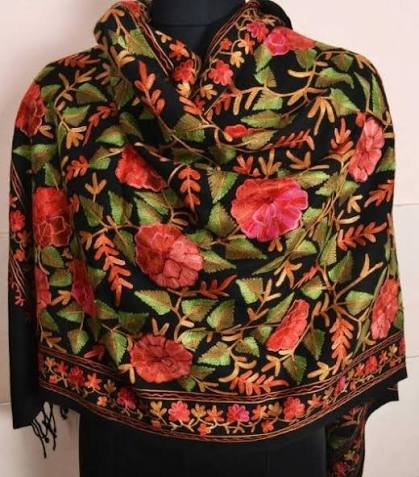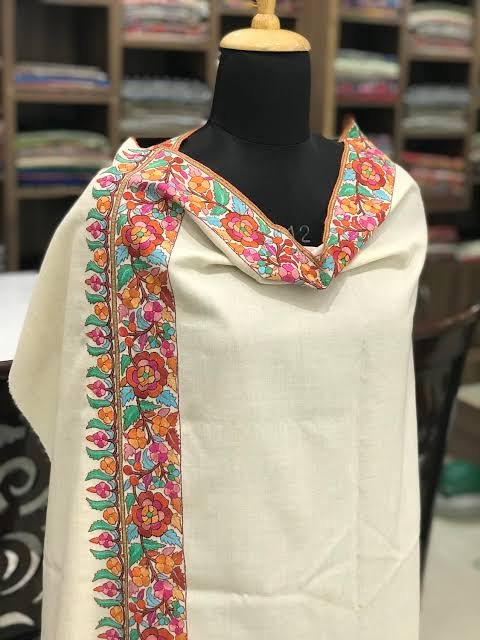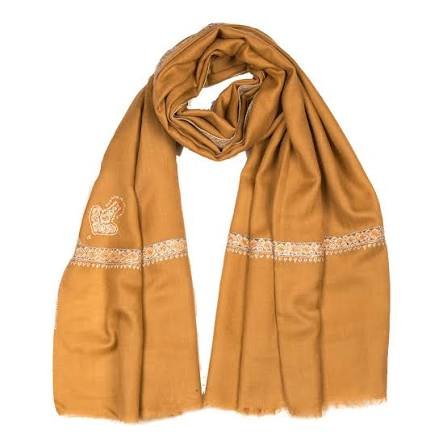

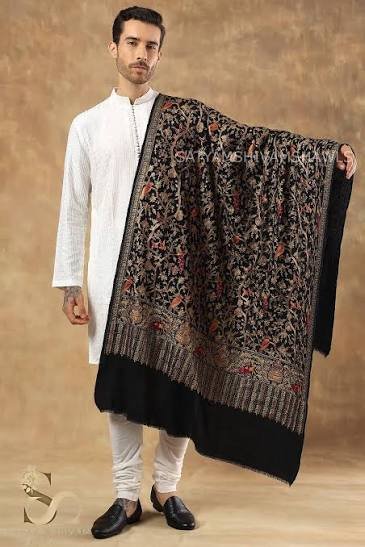
If you have ever seen a Kashmiri shawl with gold or silver-looking embroidery catching the light along its border, chances are you were looking at Tilla work. A tilla embroidery pashmina combines two celebrated Kashmiri textile traditions: a fine Pashmina base and the bold, metallic beauty of Tilla Dozi.
Unlike the soft, almost painted appearance of Sozni, Tilla is designed to be noticed. It glints, gives the shawl structure and adds an unmistakably festive, heirloom quality. A well-made tilla embroidery pashmina can look magnificent with a saree, lehenga, silk suit or even a simple winter outfit.
But the market can be confusing. Is the thread real gold? Is every tilla work pashmina shawl handmade? Why can one shawl cost a few thousand rupees and another tens of thousands? Does heavy embroidery reduce the famous softness of Pashmina?
This guide explains tilla embroidery pashmina from the craft and motifs to authenticity, price, drape, care and buying.
What Is Tilla Embroidery Pashmina?
Tilla embroidery is a traditional Kashmiri decorative technique using metallic-looking thread to create raised, reflective designs on cloth. In traditional handwork, the Tilla thread is positioned along the design and secured with supporting stitches rather than treated exactly like an ordinary sewing thread. Government craft documentation describes Tilla thread as traditionally metallic and records the use of a supporting thread to fasten it to the cloth. (handicrafts.nic.in)
Historically, Tilla was associated with gold and silver. Today, artisans commonly use metallic thread based on more affordable materials such as copper with a gold- or silver-coloured finish. This creates the characteristic shimmer of Kashmiri tilla embroidery without requiring precious-metal thread. (Asia InCH)
Tilla appears on pherans, shawls, sarees, suits and other garments. On tilla embroidery pashmina, the work needs particular control because the Pashmina base is fine, soft and flexible. Heavy or poorly executed embroidery can pull or distort such a delicate fabric.
The result can range from a narrow metallic border to large paisleys, flower sprays, decorated pallus or more elaborate all-over compositions.
What Does “Tilla Dozi” Mean?
“Tilla Dozi” is the name commonly used for the craft. Tilla refers to the decorative metallic thread, while dozi refers to embroidery or needlework.
Heritage accounts differ slightly on the precise route by which the craft reached Kashmir. Government and craft-history sources connect it with Persian or Iranian influences and with Kashmir’s wider exchange with Central Asian craft traditions; the craft later flourished with royal patronage. Rather than treating one origin story as unquestionable, it is safer to understand Tilla Dozi as part of Kashmir’s centuries-old interaction with Persianate textile traditions. (Handicrafts)
Older Tilla work could use genuine gold or silver. As precious metals became increasingly expensive, craftspeople adopted coated copper and other metallic alternatives. That history explains why a tilla dozi shawl still carries a visual language of goldwork even when no actual gold is present.
For a buyer, that distinction is important: “gold Tilla” usually describes the colour and appearance of the work, not necessarily its metal content.
How Tilla Work Is Applied to Pashmina
A handmade tilla embroidery pashmina begins well before the embroidery itself.
First comes the design. Traditional designs can be drawn on tracing paper and transferred to the fabric using a perforated pattern. Government craft documentation describes a process in which the design is first prepared and transferred to the cloth before the Tilla artisan begins embroidering. (CBSE Academic)
Once the pattern is visible, the artisan works the Tilla thread along the outline and fastens it with supporting thread. Because metallic thread is less supple than fine silk or wool thread, control matters.
This becomes even more important on tilla embroidery pashmina. Pashmina is prized for being light and supple. Good Tilla work should enrich the surface without making the underlying shawl look puckered, stretched or crudely stiff.
When comparing two shawls, inspect how cleanly the metallic line follows curves, how evenly it is secured and whether the fabric around the embroidery still falls naturally.
A beautiful design is important, but good craftsmanship is also about restraint. The embroidery should work with the Pashmina rather than overpower it.
Traditional Gold and Silver Tilla: Is It Real Gold?
This is one of the biggest misunderstandings around tilla embroidery pashmina.
Historically, real gold and silver were used in Tilla work. Craft documentation describes precious metals being worked into decorative thread, while later practice shifted towards plated or coated metal because of cost. (Asia InCH)
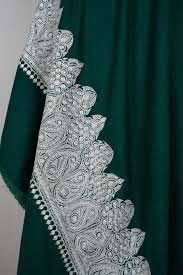
Today, most “gold Tilla” sold in the market refers to gold-coloured metallic thread. The same applies to “silver Tilla”.
So if a seller tells you that a modern tilla embroidery pashmina contains actual gold or silver, ask a simple follow-up:
What exactly is the Tilla thread made from, and is the precious-metal claim documented?
Do not assume that a ₹40,000 or ₹60,000 shawl contains gold merely because the embroidery looks golden.
For most buyers, workmanship matters more than precious-metal content. A beautifully executed hand Tilla border on authentic Pashmina is still valuable even when the metallic thread itself is not real gold.
Popular Kashmiri Tilla Embroidery Motifs
The motifs used in Kashmiri tilla embroidery belong to the larger visual vocabulary of Kashmir’s textile arts, where flowers, leaves and flowing plant forms appear repeatedly.
Popular motifs include:
- Paisley or boteh: the familiar curved teardrop form associated with Kashmiri shawls.
- Chinar leaf: one of the Valley’s most recognisable botanical symbols.
- Floral sprays: clustered flowers accompanied by leaves and stems.
- Creepers and vines: flowing designs that work especially well along borders.
- Small butis: repeated individual motifs for a lighter, less formal appearance.
- Geometric edging: structured patterns used to frame a border or pallu.
- Large pallu motifs: heavier embroidery concentrated at the two ends of a shawl.
A tilla embroidery pashmina with a small border can feel relatively understated. Broad gold-toned work on black, wine, maroon, navy or bottle green feels much more ceremonial.
Ivory, beige, natural Pashmina and softer pastel colours create an interesting contrast. The Tilla remains visible, but the overall shawl can feel lighter and more contemporary.
This is worth considering before buying. Do not judge Tilla only by how much embroidery you are getting. Sometimes a narrow, beautifully proportioned border looks far more elegant than an excessively heavy design.
Tilla vs Sozni Embroidery: What Is the Difference?
Anyone buying embroidered Pashmina eventually encounters the tilla vs sozni embroidery question.
Both are important Kashmiri embroidery traditions, but the appearance and construction are very different. Government handicrafts documentation describes Sozni as fine needle embroidery using woollen or silk threads, often producing elaborate floral and botanical designs on Pashmina and other textiles. (Handicrafts)
| Feature | Tilla | Sozni |
|---|---|---|
| Visual effect | Bold, metallic and reflective | Fine, detailed and painterly |
| Technique | Decorative metallic thread secured along the surface | Fine needle embroidery using coloured thread |
| Common placement | Borders, pallus and statement motifs | Borders, butis, jaal and detailed all-over work |
| Styling | Festive, bridal and ceremonial | Versatile, refined and classic |
| Texture | More raised and structured | Usually flatter and finer |
| Care | Protect raised metallic thread from snagging and crushing | Protect delicate stitches from pulls |
Sozni is often about minuteness: tiny stitches, subtle colour combinations and highly detailed botanical patterns.
Tilla is more graphic. The eye first notices the metallic line and the way it catches light.
Neither is automatically superior.
Choose tilla embroidery pashmina when you want visual impact, festive dressing or a statement heirloom shawl. Choose Sozni when you prefer quieter detail and a softer embroidered surface.
And yes, you can also find shawls combining more than one decorative technique.
How to Identify Hand Tilla Work on Pashmina
This is the part every buyer should understand.
You do not have to become an embroidery expert. You simply need to know what questions to ask and what to look at closely.
Look at the tiny irregularities
Genuine handwork normally contains small human variations.
Curves may not be mathematically identical. The positioning or tension may differ slightly from one section to another. These variations should be subtle.
Be careful here: poor workmanship is not automatically proof of handwork.
Loose threads, badly distorted fabric or careless finishing should not be romanticised as “handmade character”.
Turn the shawl over
The reverse can tell you a lot.
Look for evidence of the supporting or fastening stitches used to hold the metallic thread in place. A perfectly repetitive, mechanically uniform reverse deserves closer investigation if the seller is claiming entirely handmade Tilla.
Examine the Pashmina around the embroidery
Good tilla embroidery pashmina should not show obvious puckering, large holes or severe distortion around the metallic design.
Remember, the artisan is decorating an exceptionally fine textile. Clean handling of that fabric is part of the skill.
Verify the Pashmina separately
This is perhaps the most important buying lesson in the entire article.
Hand embroidery does not automatically mean pure Pashmina.
A wool shawl, wool-Pashmina blend or even another textile can carry genuine hand Tilla.
Similarly, a genuine Pashmina base can be decorated using machine embroidery.
You are therefore checking two different things:
- Is the shawl genuine Pashmina?
- Is the Tilla embroidery genuinely handmade?
Before paying a premium for tilla embroidery pashmina, ask whether the base is pure Pashmina, whether it is handwoven, whether the Tilla is handmade, where the product was made and what authenticity documentation is available.
Kashmir Pashmina itself is a registered Geographical Indication in India, so if a seller specifically claims GI-certified Kashmir Pashmina, treat that certification as something that should be verifiable rather than simply accepting a shop label. (IP India Search)
Why Tilla Embroidery Pashmina Shawls Cost More
There is no single “correct price” for tilla embroidery pashmina because several forms of value are sitting inside the same shawl.
First comes the Pashmina base.
Then comes design preparation, embroidery, finishing and the quantity of work applied.
A narrow metallic border obviously requires far less embroidery than dense Tilla covering both pallus or large sections of the shawl.
Price can be influenced by:
- quality and purity of the Pashmina base;
- hand-spinning and hand-weaving;
- amount and density of embroidery;
- complexity of the motif;
- skill of the artisan;
- time taken to complete the work;
- quality of the Tilla thread;
- finishing;
- documentation and provenance.
This is why two apparently similar tilla work pashmina shawl listings can have dramatically different prices.
Current online examples also illustrate just how broad the market is: products described as Tilla Pashmina range from lower-priced Pashmina blends to pure, heavily embroidered examples priced in the tens of thousands of rupees. (Phamb)
A very low price does not automatically prove that something is fake. But it should make you ask what exactly you are buying.
The base may be wool, viscose or a Pashmina blend. The embroidery may be machine-made. The Tilla may be inexpensive metallic yarn. There may simply be very little embroidery.
Or the word “Pashmina” may be being used loosely.
With tilla embroidery pashmina, price makes sense only when the seller can explain the material and labour behind it.
How Heavy Tilla Embroidery Affects Pashmina Drape
One reason people love Pashmina is its warmth without the heavy bulk associated with many winter woollens.
Tilla changes that equation slightly.
Metallic thread adds both weight and structure. A lightly bordered tilla embroidery pashmina can still feel very fluid, while a densely embroidered piece may drape more like an occasion shawl.
That is not necessarily a defect.
In fact, a little extra structure can look superb over sarees, lehengas, silk suits and formal winter outfits because the shawl holds its shape more prominently.
Think about how you intend to wear it.
If you want maximum softness and an easy shawl for frequent use, choose lighter Tilla placement.
If you want an heirloom piece for weddings, receptions, festivals or formal evenings, denser tilla embroidery pashmina may be exactly what you want.
When buying online, ask for:
- the finished weight;
- exact dimensions;
- close-up photographs;
- photographs of the reverse;
- and ideally a short video showing how the shawl drapes.
A photograph laid flat on a table can make a heavily embroidered shawl look deceptively light.
How to Store and Fold Tilla Pashmina
A tilla embroidery pashmina needs slightly more thoughtful storage than an ordinary shawl because you are protecting both delicate natural fibre and raised metallic work.
Store the shawl clean and completely dry.
Fold it loosely instead of crushing it underneath a tower of jeans, sweaters or other heavy clothes. If the embroidery is particularly dense, acid-free tissue between embroidered folds can help reduce rubbing.
Avoid:
- pulling the shawl roughly from a tightly packed stack;
- hanging a heavily embroidered shawl for long periods;
- making the same sharp fold through the Tilla every time;
- spraying perfume directly onto metallic embroidery;
- storing it in a damp cupboard;
- ironing directly over the Tilla work.
For long-term storage, refold your tilla embroidery pashmina occasionally so that the same section does not remain sharply creased for months or years.
The aim is simple: protect the shine without crushing the embroidery and protect the Pashmina without stretching it.
How Should a Tilla Dozi Shawl Be Cleaned?
Do not treat a tilla dozi shawl like an everyday woollen stole.
For a valuable tilla embroidery pashmina, professional dry cleaning by someone experienced with Pashmina and embellished textiles is usually the safer choice.
Make sure you tell the cleaner specifically that the shawl contains metallic embroidery.
Avoid machine washing, long soaking, rubbing stains aggressively, wringing the shawl, strong detergents and applying direct high heat over the embroidery.
For an expensive heirloom piece, ask the seller for written care instructions when you buy it and keep them with the invoice.
Buying Checklist for Tilla Embroidery Pashmina
Before buying tilla embroidery pashmina, check the following:
- Does the seller clearly state the fibre composition?
- Is it pure Pashmina, a Pashmina blend or simply wool?
- Is the base handwoven or machine-made?
- Is the Tilla work hand embroidered?
- How much of the shawl is actually embroidered?
- Can you see close-up images of both the front and reverse?
- Does “gold Tilla” mean gold colour or actual gold content?
- Does the embroidery sit smoothly without pulling or puckering?
- What is the approximate finished weight?
- Does the invoice describe the material accurately?
- If GI certification is claimed, can it be verified?
- What is the return policy?
Do not feel awkward asking these questions.
If you are spending ₹20,000, ₹40,000, ₹60,000 or more on a premium shawl, “Madam/Sir, original hai” is not enough information.
A serious seller should be comfortable explaining exactly what you are paying for.
FAQs About Tilla Embroidery Pashmina
Is Tilla embroidery made with real gold?
Historically, Tilla work could use genuine gold and silver. Today, most Tilla uses more affordable metallic thread, often based on coated metal. A gold-coloured tilla embroidery pashmina should therefore not be assumed to contain actual gold unless the seller specifically documents that claim.
Is Tilla work done by hand?
Traditional Tilla Dozi is hand embroidery. However, modern markets also contain machine-made metallic embroidery. Always ask whether the particular tilla embroidery pashmina you are considering is hand embroidered.
Is Tilla embroidery heavier than Sozni?
Usually, yes. Metallic Tilla is more raised and substantial than fine Sozni thread, so dense tilla embroidery pashmina generally has more structure and weight than a similarly sized shawl with light Sozni embroidery.
Can Tilla be added to pure Pashmina?
Yes. Skilled artisans apply Tilla to pure Pashmina, creating tilla embroidery pashmina shawls that combine a very fine base with metallic ornamentation. Because Pashmina is delicate, the embroidery needs careful control.
Why is some Tilla work inexpensive?
Inexpensive Tilla can have several explanations: a wool or synthetic base rather than pure Pashmina, machine embroidery, inexpensive metallic thread, minimal handwork or simply much less embroidery. A very low-priced tilla embroidery pashmina deserves closer questions about both the shawl and the embroidery.
How should a Tilla Pashmina be cleaned?
For a valuable tilla embroidery pashmina, use a professional cleaner familiar with Pashmina and embellished textiles. Avoid machine washing, wringing and ironing directly over the metallic work.
Final Word: Is a Tilla Embroidery Pashmina Worth Buying?
If you prefer very quiet, barely visible embroidery, Tilla may not be your first choice.
But if you want a shawl that feels festive, distinctly Kashmiri and worthy of special occasions, a good tilla embroidery pashmina can be spectacular.
The smart way to buy is to separate beauty from proof.
Admire the colour, motif and metallic shine, but also verify the Pashmina base, the embroidery method and any certification claims.
Once you understand the craft, tilla embroidery pashmina becomes much easier to buy intelligently.
You are no longer simply choosing “a shawl with gold work”.
You are looking at the meeting point of fine Pashmina weaving and one of Kashmir’s most recognisable decorative traditions.
See Also
- Kashmiri Tilla Sozni Shawl Designs || Semi pashmina bridal wardan shawls
- Kashmiri silk tilla suits | Kashmiri embroidery suits | Traditional tilla embroidery
- Kani Weave vs Sozni Embroidery Pashmina: The Ultimate Heritage Guide
- Understanding the Needle: The History of Kashmiri Sozni Embroidery
- How Much Does a Real Kani Shawl Cost? 2026 Price & Buying Guide