
Pashmina and Shahtoosh are sometimes mentioned together because both are exceptionally fine Himalayan animal fibres. But that similarity can be dangerously misleading.
The Pashmina vs Shahtoosh difference is not simply about softness, price or rarity. Pashmina comes from domesticated goats and is legally produced and sold. Shahtoosh comes from the Tibetan antelope, or chiru, a protected wild animal, and its trade is prohibited.
For an Indian buyer, knowing the difference matters not only for authenticity but also for wildlife law and responsible shopping.
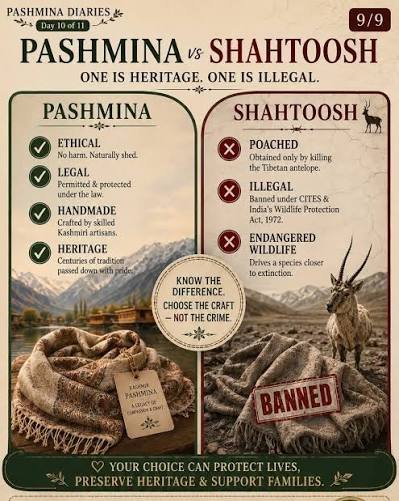
Pashmina vs Shahtoosh: What Is the Difference?
Pashmina and Shahtoosh are not the same. Pashmina is obtained from the fine undercoat of domesticated high-altitude goats and can be legally produced and traded. Shahtoosh comes from the Tibetan antelope, or chiru. Trade in Shahtoosh is prohibited in India, while international commercial trade is tightly prohibited under the chiru’s CITES Appendix I protection. (Press Information Bureau)
Pashmina vs Shahtoosh: Quick Comparison
| Factor | Pashmina | Shahtoosh |
|---|---|---|
| Animal source | High-altitude Pashmina/Changthangi goat | Tibetan antelope or chiru |
| Scientific source | Domestic goat (Capra hircus group) | Pantholops hodgsonii |
| Production | Fine undercoat collected from domesticated goats | Historically linked to poaching and killing wild chiru |
| Legal trade in India | Permitted when genuine and properly represented | Prohibited |
| International wildlife status | Normal legal textile trade | Chiru is listed in CITES Appendix I |
| Certification | GI and textile verification may apply | No legitimate retail Shahtoosh certification |
| Buyer action | Verify fibre composition, origin and seller claims | Do not purchase or transport |
| Ring test | Not reliable proof | Not reliable proof |
| Laboratory testing | Microscopy and fibre analysis can help authenticate it | Specialist microscopy, DNA and protein methods can identify chiru fibre |
The recent relevance of the Pashmina vs Shahtoosh issue is not theoretical. In April 2026, India’s Press Information Bureau reported the conviction of a trader in a case involving an attempt to export Shahtoosh shawls. The government reiterated that the Tibetan antelope is listed in Schedule I of the Wild Life (Protection) Act and that trade in Shahtoosh is strictly prohibited. (Press Information Bureau)
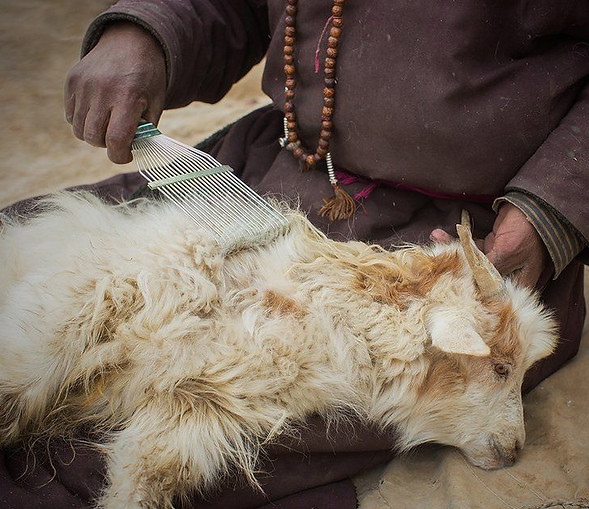

Visual reference: a Changthangi/Pashmina goat being combed and the wild Tibetan antelope or chiru.
Which Animals Produce Pashmina and Shahtoosh?
The easiest way to understand the Pashmina or Shahtoosh difference is to start with the animals.
Pashmina is traditionally associated with fine undercoat fibre produced by high-altitude goats, particularly the Changthangi or Changra goats of Ladakh. These are domestic livestock maintained by pastoral communities.
The Government of India’s handicrafts portal explains that the soft pashm forms part of the goat’s winter insulation. When the season changes, the fibre rises and can be combed from the animal. The fibre is then cleaned, dehaired, spun and eventually woven. (Handicrafts)
Shahtoosh has an entirely different origin.
It is made from the exceptionally fine underfur of the Tibetan antelope, also known as the chiru, scientifically Pantholops hodgsonii. Unlike Changthangi goats, these are wild animals rather than domesticated fibre-producing livestock.
That biological distinction is at the heart of the Pashmina vs Shahtoosh debate.
Why Can Pashmina Be Collected Without Killing the Goat?
One of the biggest misunderstandings surrounding Pashmina vs Shahtoosh is the idea that both fibres must be obtained in roughly the same way.
They are not.
Changthangi goats grow a fine insulating undercoat during the severe Himalayan winter. As warmer weather arrives, this winter coat begins loosening. Traditional producers can collect the pashm through combing.
A 2026 Ladakh Administration report describes Pashmina from its goat farms as being extracted using a traditional combing technique before being sent for dehairing and processing. (Ladakh Government)
The goat therefore remains part of a continuing pastoral system. It can grow another winter coat in subsequent seasons.
This makes legal Pashmina fundamentally different from the wildlife exploitation behind the Shahtoosh trade.
Why Is Shahtoosh Banned in India?
If you search “why Shahtoosh is banned,” the answer begins with wildlife conservation.
Shahtoosh comes from the chiru. In India, the Tibetan antelope is included in Schedule I of the Wild Life (Protection) Act, 1972, which gives it the law’s highest schedule-based protection. (India Code)
The species is also listed in CITES Appendix I, the category covering species for which international commercial trade is subject to the Convention’s strongest restrictions. (CITES)
Commercial Shahtoosh production historically created a powerful incentive to hunt wild chiru for their extremely fine underfur. This is why the discussion cannot be reduced to whether a shawl is luxurious or rare.
It is a wildlife-trade issue.
The seriousness of enforcement was highlighted again on 15 April 2026, when the Ministry of Environment, Forest and Climate Change announced the conviction arising from an attempted illegal export of Shahtoosh shawls. (Press Information Bureau)
So, is Shahtoosh legal in India? For ordinary shoppers looking to buy a shawl, the practical answer is no: Shahtoosh is not a lawful luxury textile to purchase and trade.
Is Pashmina Legal to Buy and Carry?
Yes. Genuine Pashmina is a legal textile.
There is nothing inherently illegal about buying, owning or travelling with an authentic Pashmina shawl made from legal goat fibre.
That is another essential Pashmina vs Shahtoosh distinction.
However, buyers should still pay attention to what exactly a seller is claiming. “Pashmina,” “Kashmir Pashmina,” “cashmere,” “Pashmina blend” and “Pashmina-style shawl” are not automatically interchangeable descriptions.
If the product is being sold specifically as Kashmir Pashmina, GI authentication becomes particularly relevant.
India’s GI Registry records Kashmir Pashmina as GI Application No. 46, with Certificate No. 97. (Intellectual Property India)
A proper bill stating the material, seller identity and product description is also useful. Never rely purely on verbal assurances such as “100% original” or “family Pashmina.”
Why Is Shahtoosh Sometimes Mislabelled as Pashmina?
Historically, the fibres have been confused partly because both are extremely fine, lightweight and warm.
But modern wildlife trafficking creates another problem: illegal fibres may be concealed, mixed with legal fibres or inaccurately labelled.
Scientific research specifically notes the difficulty of distinguishing Shahtoosh from Pashmina because of similarities in fineness, colour and texture. Researchers have therefore developed increasingly sophisticated methods for differentiating the two. (ScienceDirect)
This means that a label saying “Pashmina” is not conclusive evidence about an unknown textile.
For a normal shopper, however, the safest response is not to become a wildlife forensic expert. Buy from sellers who provide clear fibre information and traceability, and stay away from anyone presenting Shahtoosh as a secret luxury upgrade.
Terms such as “old Shahtoosh,” “legal Shahtoosh,” “collector’s Shahtoosh,” “pre-ban Shahtoosh” or “Shahtoosh-type Pashmina” deserve particular caution because legal consequences can depend on facts and documentation that a shopkeeper’s reassurance cannot establish.
Can Touch or the Ring Test Identify Pashmina vs Shahtoosh?
No.
The famous ring test is one of the most persistent myths surrounding both Pashmina and Shahtoosh.
The idea is simple: an exceptionally fine shawl is supposed to pass through a small finger ring. Shahtoosh became particularly famous for this characteristic.
But passing through a ring demonstrates little more than the thinness, softness and compressibility of a particular fabric.
Fine Pashmina, silk blends and various lightweight fabrics may also pass through a ring. Meanwhile, a genuine but heavier Pashmina shawl may not.
Scientific literature discussing Shahtoosh identification notes its famous association with the ring test but relies instead on microscopic, DNA or protein characteristics for meaningful species identification. (ScienceDirect)
So when comparing Pashmina vs Shahtoosh, treat the ring test as folklore rather than authentication.
How Do Laboratories Differentiate Pashmina and Shahtoosh?
This is where the Pashmina vs Shahtoosh question becomes genuinely scientific.
To the naked eye, very fine animal fibres can be remarkably similar. Under laboratory conditions, however, specialists can examine characteristics that shoppers cannot reliably see.
Microscopic fibre examination
Light microscopy and scanning electron microscopy can reveal surface-scale structures and characteristics of guard hairs.
Shahtoosh has microscopic features that experienced forensic analysts can differentiate from goat cashmere or Pashmina.
DNA analysis
Species-specific DNA techniques can identify biological material belonging to the Tibetan antelope.
A published real-time PCR method was capable of detecting Shahtoosh DNA even in mixed-fibre samples, demonstrating why laboratory analysis is far more meaningful than touching or pulling a shawl through a ring. (PubMed)
Protein analysis
Researchers have also demonstrated MALDI-TOF mass-spectrometry techniques that detect species-specific protein markers associated with Shahtoosh. (ScienceDirect)
Spectroscopy
Indian wildlife-forensics research has explored ATR FT-IR spectroscopy combined with statistical analysis as a rapid, non-destructive method for separating Shahtoosh, Pashmina and other animal fibres. (ScienceDirect)
The takeaway is simple: Pashmina vs Shahtoosh cannot be reliably settled by touch alone.
For a deeper explanation of fibre testing, read our internal guide: The Microscopic Truth: How a Lab Identifies Fake Cashmere.
Certification and Traceability for Legal Pashmina
Legal Pashmina has something Shahtoosh cannot legitimately offer: a transparent commercial supply chain.
For premium purchases, look for documentation appropriate to the seller’s claims.
If something is sold specifically as GI-certified Kashmir Pashmina, ask to see the authentication details rather than relying on the words “Kashmiri” or “pure.”
Kashmir Pashmina is officially registered as a geographical indication in India, and the GI Registry maintains records of the registration and authorised users. (Intellectual Property India)
For your next step, see our detailed guides to the Kashmir Pashmina GI Tag Lookup and How to Check Kashmir Pashmina GI Tag Online.
Remember, though, that the GI relates specifically to Kashmir Pashmina. It should not be treated as a universal certificate covering every legal cashmere or Pashmina product in the world.
What Should You Do If a Seller Offers Shahtoosh?
This is one area where there is no reason to experiment.
If a seller explicitly offers you Shahtoosh:
- Do not buy it.
- Do not agree to transport, courier or carry it for someone else.
- Do not assume calling it antique, inherited or pre-ban automatically makes a transaction lawful.
- Do not buy a small piece simply to “test” whether it is genuine.
- If the circumstances genuinely suggest illegal wildlife trade, information can be passed to the appropriate wildlife authorities, including the Wildlife Crime Control Bureau or the relevant state wildlife authorities.
The Wildlife Crime Control Bureau is the Government of India’s statutory body for combating organised wildlife crime and coordinating enforcement under wildlife law. (MoEFCC)
In other words, when Pashmina vs Shahtoosh becomes a sales conversation, choose traceable Pashmina and walk away from Shahtoosh.
What Should You Do with a Suspected or Inherited Shahtoosh Shawl?
This situation needs more care than an ordinary shopping question.
Perhaps you have found an old family shawl in a trunk and someone says, “This might be Shahtoosh.”
Do not assume that because it was inherited, old or purchased decades ago you are automatically free to sell, gift, transport or export it.
India’s wildlife legislation contains specific provisions dealing with possession, inheritance, declaration and wildlife articles derived from protected species. The application of those provisions depends on the actual item and circumstances. (India Code)
The safest course is therefore to leave the piece where it is and seek guidance from the competent wildlife authority before selling, transporting, gifting or sending it for testing.
The Wildlife Crime Control Bureau maintains regional offices around India and works with state enforcement authorities. (WCCB)
This article deliberately does not suggest an “amnesty,” automatic surrender route or blanket exemption for inherited pieces because the appropriate procedure should come from the competent authority handling the particular case.
If scientific identification is required, ask the authority what recognised laboratory or procedure should be used rather than simply posting the textile to an unknown commercial tester.
Ethical Alternatives to Shahtoosh
Fortunately, you do not need Shahtoosh to own an extraordinarily soft Himalayan shawl.
High-quality Pashmina offers fineness, warmth, drape and centuries of textile tradition without creating demand for illegal chiru products.
Other legitimate options include high-quality cashmere, certified Kashmir Pashmina and clearly labelled Pashmina-silk blends where a lighter finish is preferred.
The important point is transparency.
A legal textile does not have to hide behind secret descriptions, whispered offers or stories about customs officers.
That may be the most useful way to remember the Pashmina vs Shahtoosh difference: one can support pastoral livelihoods and living craft traditions; the other belongs to the world of protected wildlife and prohibited trade.
Quick Checklist: Pashmina vs Shahtoosh Before You Buy
Before purchasing an expensive shawl in India, check these points:
- Animal source: goat fibre is consistent with Pashmina; Tibetan antelope fibre means Shahtoosh.
- Seller terminology: avoid any product openly marketed as Shahtoosh.
- Invoice: get the material description in writing.
- GI claim: if sold specifically as GI-certified Kashmir Pashmina, verify the authentication details.
- Ring test: never treat it as proof.
- Suspicious antique claims: do not assume “old” means legally tradable.
- Laboratory testing: use appropriate scientific testing when genuine identification is necessary.
- Inherited suspected Shahtoosh: consult WCCB or the relevant wildlife authority before moving, selling or testing the piece.
FAQs About Pashmina vs Shahtoosh
Is Pashmina banned in India?
No. Pashmina itself is not banned in India. It is a legal animal fibre produced from domesticated goats. The legal problem concerns Shahtoosh, which originates from the protected Tibetan antelope.
Why is Shahtoosh illegal?
Shahtoosh is associated with the exploitation and killing of wild Tibetan antelope for their exceptionally fine underfur. The chiru is protected under Schedule I of India’s Wild Life (Protection) Act and listed in CITES Appendix I. Trade in Shahtoosh is therefore prohibited in India. (Press Information Bureau)
Is the ring test used for Shahtoosh or Pashmina?
It has historically been associated particularly with Shahtoosh, but it is also widely promoted as a Pashmina test. In either case, it is not reliable authentication. A lightweight fabric passing through a ring does not establish its animal species.
Can Shahtoosh be obtained without killing an animal?
Naturally shed animal hair can exist, but there is no legitimate commercial Shahtoosh supply chain based on harmless collection from living wild chiru. The historical commercial trade has been associated with poaching and killing Tibetan antelope. Buyers should not treat claims of “cruelty-free Shahtoosh” as a route around wildlife law.
Can a laboratory distinguish Shahtoosh from Pashmina?
Yes. Specialist laboratories can use microscopic characteristics as well as DNA-, protein- and spectroscopy-based techniques to differentiate fibres. These methods are much more reliable than touch, appearance or the ring test. (PubMed)
What should I do if a seller offers Shahtoosh?
Do not purchase or transport it. If circumstances suggest illegal wildlife trafficking, contact the appropriate wildlife authorities rather than trying to investigate or purchase the item yourself.
Can an old family shawl be tested for Shahtoosh?
Potentially, yes, because laboratory methods can identify animal fibres. But if there is a genuine reason to suspect Shahtoosh, contact the Wildlife Crime Control Bureau or appropriate state wildlife authority before transporting or submitting the piece, so that identification is handled in accordance with current legal guidance.
Final Word on Pashmina vs Shahtoosh
The confusion around Pashmina vs Shahtoosh survives because both names have long been associated with rare, fine Himalayan shawls. Legally, ethically and biologically, however, they belong in completely different categories.
Pashmina comes from domesticated goats and remains part of a living pastoral and textile tradition. Shahtoosh comes from the protected Tibetan antelope and its trade is prohibited.
So when buying a luxury shawl, don’t ask only whether it feels exceptionally soft. Ask what fibre it contains, where it came from, what documentation supports the claim and whether the seller is willing to put that description on the invoice.
That is a far more reliable test than any ring.
See Also
- Shahtoosh vs Pashmina: Understanding the Differences and Similarities
- Difference Between Shahtoosh and Pashmina Shawls
- Pashmina vs Shahtoosh: Differences, Legality and Ethical Buying
- Papier-Mâché Embroidery on Pashmina: Meaning, Technique and Identification
- The Journey of Raw Pashm: How Is Kashmiri Pashmina Made Step by Step?
- Kashmir Pashmina GI Tag Lookup: How to Check the Seal Online Before Buying