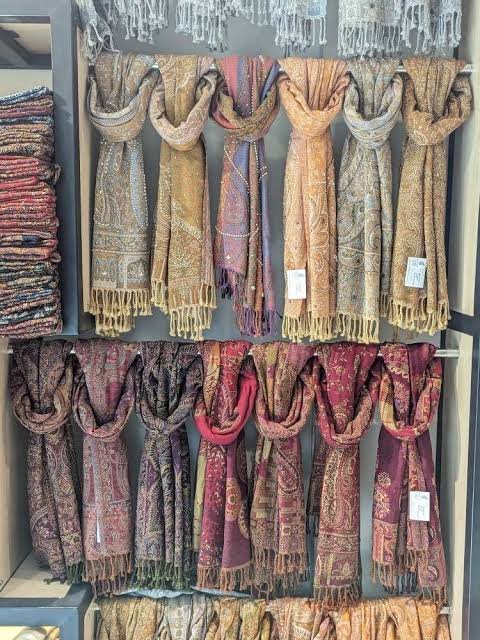

Pashmina shawls do not have one universal standard size. Dimensions vary by intended use, weaving tradition, and design. Measure the length and width of the finished piece, including whether the stated dimensions account for fringes.
If you have ever browsed online for an authentic Kashmiri wrap, you have probably noticed something puzzling. One seller lists a “standard shawl” at 80 x 40 inches, while another calls a 100 x 50-inch piece the exact same thing. And just when you think you have figured it out, a third store throws terms like dupatta, rumal, and stole into the mix without explaining how big they actually are!
At Pashmina Shawl India, we get messages every single week from buyers across Delhi, Mumbai, Bengaluru, and Kolkata asking the exact same question: “Which size will actually drape well on my frame without looking too bulky or too short?”
Because real Pashmina is a luxury investment—often costing anywhere from ₹15,000 for a plain weave to several lakhs for intricate Kani or Sozni embroidery—getting the dimensions wrong can be heartbreaking. Unlike machine-made acrylic winter wear churned out in factories, authentic Changthangi Pashmina is spun and woven by hand on traditional wooden looms in Kashmir. That human touch gives every piece its soul, and it also means sizing follows traditional craft ranges rather than rigid factory templates.
In this comprehensive guide, we will break down Pashmina shawl standard sizes in inches (and centimetres), compare shawls against stoles and scarves, show you how to measure a piece properly at home, and help you pick the exact right dimensions for weddings, office wear, travel, or gifting.
What Are the Common Dimensions of a Pashmina Shawl?
When shopping in India, most traditional weavers and established heritage brands group handwoven Pashmina into four broad size categories. While there is no central regulatory body enforcing exact millimetre measurements, decades of Kashmiri weaving tradition have settled into practical, wearable proportions that suit Indian body types and outfits—whether you are pairing your wrap with a Kanjeevaram silk saree, an Anarkali suit, or a tailored winter blazer.
Below is an approximate size chart covering the most common Pashmina formats available in the Indian market. Remember that handloom textiles naturally vary by 1 to 2 inches due to loom tension and hand-finishing. (Standard Shawl, Stole and Scarf Sizes: A Dimension Chart for Wholesale Orders)
| Product Type | Approximate Dimensions (Inches) | Approximate Dimensions (Centimetres) | Typical Use & Styling |
| Pashmina Scarf / Muffler | 60″ – 72″ × 12″ – 18″ | 152 – 183 cm × 30 – 46 cm | Everyday neck wrapping, men’s winter styling, pairing with coats or kurtas |
| Pashmina Stole | 70″ – 80″ × 28″ – 32″ | 178 – 203 cm × 71 – 81 cm | Light shoulder draping, office wear, Indo-western outfits, easy travel layering |
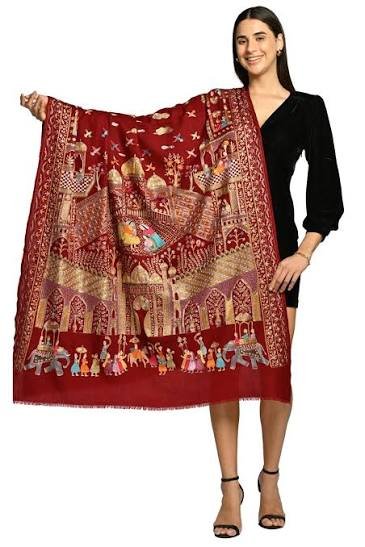
| Standard Pashmina Shawl | 80″ – 90″ × 40″ – 45″ | 203 – 229 cm × 102 – 114 cm | Classic full-body draping, sarees, festive wear, gifting, traditional winter warmth |
| Large / Bridal Shawl (Doshala / Rumal) | 100″ – 110″ × 50″ – 55″ | 254 – 279 cm × 127 – 140 cm | Heavy bridal trousseaus, men’s ceremonial shawls, dramatic double-fold draping |
Note: All dimensions listed above are approximate industry ranges rather than rigid universal standards. Always verify exact product measurements before purchasing.
Understanding the Classic 80 x 40 Inches Benchmark
If you ask a master weaver in Srinagar for a “regular” ladies’ Pashmina shawl, nine times out of ten they will pull out a piece measuring 80 inches by 40 inches (roughly 203 cm by 102 cm). Why did this specific ratio become the gold standard?
Simple geometry and ergonomics. A 2:1 length-to-width ratio allows you to fold the shawl lengthwise into a neat 20-inch-wide band to rest gracefully over one shoulder—the classic Indian saree drape—or open it fully across both shoulders so it covers your torso down to the hips without dragging on the floor. For an average Indian height between 5’1″ and 5’7″, 80 x 40 inches hits the sweet spot between generous coverage and effortless handling.
Shawl vs Stole vs Scarf: Size Comparison and Styling Differences
One of the biggest sources of confusion when checking Pashmina shawl standard sizes in inches is overlapping terminology. Many online marketplaces use the words “shawl,” “stole,” and “scarf” interchangeably to catch more search traffic. However, in authentic Kashmiri craftsmanship, each term represents a very distinct garment width and draping style.
Let’s clear up the confusion once and for all.
1. The Pashmina Scarf (Muffler)
- Typical Size: 60–72 inches long × 12–18 inches wide
- Weight & Feel: Featherlight, usually between 60 and 100 grams.
- How It Wears: A scarf is narrow by design. You cannot drape it across your back like a blanket; instead, it is meant to be looped around your neck once or twice, tucked inside a trench coat, or worn casually over a crisp white shirt or bandhgala jacket. In North India, men frequently refer to this size as a muffler. Because it uses less yarn than a full shawl, a pure Pashmina scarf is also the most budget-friendly entry point into authentic Ladakhi cashmere.
2. The Pashmina Stole
- Typical Size: 70–80 inches long × 28–32 inches wide
- Weight & Feel: Light to medium, typically 110 to 160 grams (unless heavily embroidered).
- How It Wears: Think of a stole as the modern, versatile middle child. It has almost the same length as a standard shawl, so it hangs gracefully down your front, but it is roughly 10 to 12 inches narrower. That narrower width eliminates bulk around the arms and waist. If you love wearing Pashmina with western formals, dresses, or lightweight cotton-silk kurtas, a stole gives you warmth without feeling like you are wrapped in a heavy quilt.
3. The Standard Pashmina Shawl
- Typical Size: 80–90 inches long × 40–45 inches wide
- Weight & Feel: Substantial yet airy, generally 180 to 300 grams for plain or border-embroidered weaves, and up to 450+ grams for dense Jamawar or Kani weaves.
- How It Wears: A true shawl is wide enough to envelop your entire upper body. When opened up, it functions like a wearable heirloom blanket—keeping out the biting January chill of Delhi, Chandigarh, or Shimla. You can pleat it neatly over one shoulder with a heavy Banarasi saree or wrap it completely around both arms during outdoor winter weddings.
4. The Men’s Lohi / Ceremonial Shawl & Bridal Doshala
- Typical Size: 100–110 inches long × 50–55 inches wide
- Weight & Feel: Generous and regal, often 350 to 600+ grams.
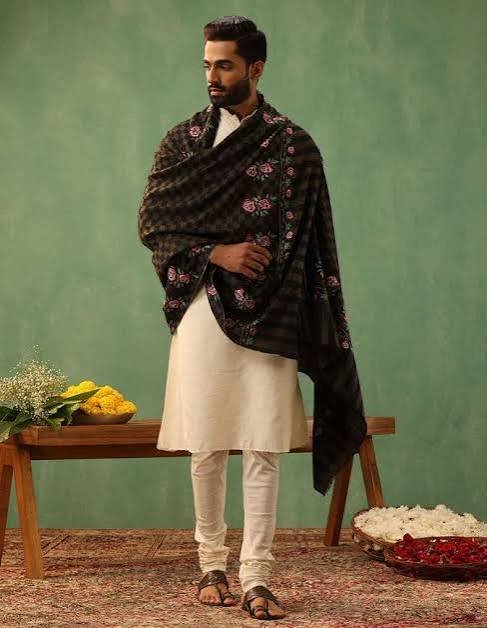
- How It Wears: Men’s traditional shawls (often called Lohi or Chadar) and royal bridal shawls (Doshala or large Rumals) require extra yardage to accommodate broader shoulders, taller frames, or elaborate double-layered draping over a sherwani or bridal lehenga.
How to Measure a Pashmina Correctly (Length, Width, and Fringe Allowance)
Whether you are verifying an online order that just arrived at your doorstep or measuring a family heirloom to get it custom-framed or dry-cleaned, knowing how to measure delicate handwoven fabric without stretching it is essential. Pure Changthangi wool has natural elasticity; pulling it taut while measuring can easily skew your reading by 2 or 3 inches.
Follow these three straightforward steps on a clean, flat surface like a dining table or freshly made bed.
1. Measuring the Length
Lay the Pashmina completely flat and smooth out any creases gently with the palm of your hand—never tug on the corners. Using a flexible tailor’s measuring tape (or a rigid metal tape measure), measure straight down the centre from one end of the woven fabric to the opposite end. Measuring down the middle rather than along the outer edge prevents inaccuracies caused by slight hand-loom curvature.
2. Measuring the Width
Keep the fabric relaxed and measure straight across the middle from the left selvedge (finished side edge) to the right selvedge. For a standard shawl, you should see a reading close to 40 inches (101.6 cm). If your piece has heavily embroidered borders (Hashia) sewn onto the edges, measure from the outermost edge of one border to the outermost edge of the other.
3. Accounting for Fringe Allowance
This is where buyers and sellers frequently misunderstand each other. Handwoven Pashminas typically feature twisted or hand-knotted fringes (jalakdozi or natural warp tassels) at both short ends, usually adding 2 to 4 inches per side (4 to 8 inches total).
- Body Measurement (Net Size): Measures only the woven cloth from end to end, excluding the loose tassels.
- Total Measurement (Gross Size): Includes the fringes on both ends.
For instance, a shawl listed as “80 x 40 inches” might actually have a 76-inch woven body with 2-inch fringes on either side, or an 80-inch woven body with 3-inch fringes extending beyond it. Always ask the seller whether their stated Pashmina shawl standard sizes in inches refer to the woven body alone or the total tip-to-tip length.
Which Pashmina Dimensions Work Best for Different Uses?
Buying the biggest shawl available isn’t always the smartest move. A massive 108-inch bridal shawl will feel overwhelming on a daily flight, while a narrow 28-inch stole might leave you shivering at an outdoor December reception in Jaipur. Match your dimensions to how you actually plan to wear the piece.
Shoulder Draping (Everyday Ethnic & Festive Wear)
- Best Dimensions: 80″ × 40″ (Standard Shawl) or 80″ × 30″ (Wide Stole)
- Why It Works: When you drape a Pashmina over one shoulder or wrap it loosely around both arms over a salwar kameez or saree, you want enough length so the ends fall gracefully around mid-thigh or knee level. An 80-inch length achieves this effortlessly without the corners dipping into your plate at a dinner party! If you are under 5’2″, leaning toward a 76″–80″ length with a 30″–36″ width keeps your silhouette balanced rather than drowned in fabric.
Neck Wrapping (Office, Winter Commutes & Casual Outings)
- Best Dimensions: 65″–72″ × 14″–18″ (Scarf) or 72″–80″ × 28″ (Light Stole)
- Why It Works: Wrapping a full 40-inch-wide shawl around your neck creates a thick, bulky ring that restricts head movement and looks awkward under a structured coat or blazer. A 14-to-28-inch width folds flat and soft against your collarbone, trapping body heat right where you need it most while looking sharp and tailored.
Formal and Wedding Wear (Brides, Grooms & Guests)
- Best Dimensions: 85″–90″ × 42″–45″ (Ladies’ Bridal/Heavy Embroidered Shawl) or 100″–108″ × 50″–54″ (Groom’s Sherwani Shawl / Bridal Doshala)
- Why It Works: Wedding outfits—especially silk sarees, velvet lehengas, and heavily embroidered sherwanis—have considerable volume. A wider shawl (42 inches and above) drapes smoothly over heavy zari blouses and structured shoulders without slipping off. For brides carrying a Kani or full-field Sozni Jamawar shawl as a second dupatta or evening wrap, extra width ensures the intricate artwork displays flat and unobstructed in wedding photographs.
Travel (Flights, Road Trips & Cold Destinations)
- Best Dimensions: 80″ × 35″–40″ (Lightweight Plain or Bordered Shawl)
- Why It Works: Frequent flyers swear by pure Pashmina because it packs down to the size of a small pouch yet delivers remarkable warmth-to-weight performance. At 80 × 36–40 inches, a single piece doubles as an airplane blanket, a cozy wrap during chilly hotel breakfasts in Europe or Himachal, and an instant evening dress-up layer when paired with simple jeans and a sweater.
Why Do Two Shawls of the Same Name Have Different Dimensions?
Have you ever laid two “80 x 40 inch” Pashmina shawls side by side, only to discover one is noticeably longer or wider than the other? You haven’t been cheated—you are witnessing the reality of authentic, non-mechanized Indian craftsmanship. Here are four genuine reasons why dimensions fluctuate even within the exact same product category:
1. Handloom Setup and Weaver Tension
Traditional Kashmiri Pashmina is woven on wooden handlooms (wovun) without automated tension sensors. Before weaving begins, the master warp-maker (nakatu) winds thousands of delicate, hand-spun threads onto the loom by hand. Slight variations in how tightly the weaver beats the weft thread with the wooden comb (saaz) or how humid the weather is in Srinagar during weaving can cause the finished cloth to contract or relax by 1 to 2 inches.
2. Post-Weaving Washing and Finishing (Purzgar & Dhobi Process)
Raw Pashmina coming off the loom feels slightly crisp and uneven. It goes through a traditional artisanal finishing cycle: gentle hand-washing in soft spring water, wooden-mallet softening, and careful tweezer-cleaning (purz) to remove tiny guard hairs. During washing and natural air-drying, natural animal fibres relax and shrink slightly—typically by 3% to 5%. Two shawls woven on the exact same loom can finish at slightly different sizes depending on yarn ply and wash duration.
3. Embroidery Pull and Heavy Needle-Work
If you compare a plain Kora (undyed) Pashmina shawl with an intricate Sozni or Tilla embroidered piece started at the exact same loom size, the embroidered shawl will often measure 1 to 2 inches smaller. Thousands of tiny hand-stitches pull the delicate cashmere weave gently inward over months or years of needlework, creating a slightly tighter, denser drape.
4. Regional vs. Export Sizing Preferences
A weaver creating stock primarily for traditional North Indian wedding markets will often warp the loom slightly wider (42 to 45 inches) because Indian women love full coverage over sarees. Conversely, workshops weaving for contemporary urban boutiques or international buyers frequently set looms at 30 to 36 inches wide to suit modern, minimalist layering.
What Measurements Should You Request When Buying Online?
Shopping for high-value handloom textiles online requires a bit of smart homework. Good sellers love informed buyers because clear communication prevents returns and builds trust. Before you click “Buy Now” or transfer funds over WhatsApp to a Kashmiri artisan or boutique, send a quick message asking for these five specific details:
- Exact Finished Body Length and Width (in Inches): Ask for the real tape-measure reading of the specific piece you are buying—not just a copy-pasted template description from their website.
- Fringe Inclusion Clarification: Explicitly ask, “Does this measurement include the fringes, or is it the woven fabric size only?” Also ask how long the fringes are on each side.
- Border Width (If Embroidered): If you are eyeing a Hashia (four-side border) or Palla (end-border) shawl, ask how wide the embroidered border is (e.g., 2 inches vs. 6 inches). Wide borders add visual weight and structure to how the shawl folds on your shoulder.
- Approximate Gram Weight: While not a linear dimension, weight (in grams) tells you how dense the weave is relative to its size. For instance, an 80″ × 40″ plain shawl weighing 180 grams will feel cozy and substantial, whereas an 80″ × 40″ Ring Pashmina weighing 95 grams will feel gossamer-thin and semi-sheer.
- Flat-Lay Photo with a Measuring Tape (For High-Ticket Pieces): For heirloom Kani, Jamawar, or heavily embroidered bridal shawls, reputable sellers will gladly send a quick smartphone photo or video of the piece laid flat with a measuring tape beside it—alongside its GI (Geographical Indication) tag details.
Frequently Asked Questions (FAQs)
How long should a Pashmina stole be?
A standard Pashmina stole should ideally be 70 to 80 inches (178 to 203 cm) long and 28 to 32 inches (71 to 81 cm) wide. This length allows the stole to drape over your shoulders with the ends falling comfortably near your mid-thigh, or loop once around your neck with balanced tails hanging in front. If you are taller than 5’8″, look for a stole closer to 80 inches so the proportions still feel generous.
Are fringes included in shawl measurements?
There is no single rule across all Indian brands—some sellers measure only the woven body of the shawl, while others measure from the tip of one fringe to the tip of the other. On average, hand-twisted fringes add 2 to 4 inches on each end (4 to 8 inches combined). Because of this difference, always confirm with the seller whether their listed Pashmina shawl standard sizes in inches reflect the net woven cloth or the gross length with tassels.
What size Pashmina is best for a gift?
For gifting—whether for a wedding trousseau, Diwali, an anniversary, or a milestone birthday—a standard shawl measuring 80 × 40 inches is the safest and most universally appreciated choice for women. It works across all heights, drapes effortlessly over both sarees and western outfits, and feels undeniably luxurious. If you are gifting a gentleman, go for a men’s scarf/muffler (70 × 15 inches) for everyday office wear or a full Lohi shawl (100 × 50 inches) for ceremonial occasions.
Is an 80 x 40 inch Pashmina big enough to wear with a saree?
Yes, 80 × 40 inches is the classic, time-tested dimension for wearing a Pashmina with a saree. You can fold it neatly lengthwise into thirds to pin over your left shoulder alongside your saree pallu, or drape it open across both shoulders during chilly outdoor functions without the fabric bunching awkwardly around your waist.
Why do some authentic Pashminas feel smaller even when the label says 80 x 40 inches?
Pure Pashmina is ultra-fine (12 to 16 microns thick) and drapes closer to the body than stiff sheep wool or bulky acrylic shawls. Because it lacks stiffness and moulds softly around your shoulders without puffing out, an 80 × 40 inch authentic Pashmina can visually appear sleeker and more compact than a synthetic shawl of the exact same dimensions.
Ready to Find Your Perfect Fit?
Now that you know how Pashmina shawl standard sizes in inches translate into real-world comfort and style, choosing your next heirloom wrap becomes much easier. Whether you want a breezy 75 × 30-inch stole for daily elegance or a regal 90 × 45-inch hand-embroidered shawl for wedding season, always let your height, outfit volume, and draping style guide your final pick.
See Also
- Party Wear Pashmina Shawl For Women, Embroidered Shawl, Stall, Pashmoda Shawl Review
- Pure Pashmina Shawl
- Pashmina Shawl Size Guide: Shawl vs Stole vs Scarf Dimensions
- Best Minimal Pashmina Stoles for Wedding Guests: 2026 Style Guide
- Original Pashmina Shawl Price in India Standard Rate: Your Price Guide 2026