
You are sitting in a cozy showroom, and the salesperson glides an ethereal, matte fabric across your fingers. It feels incredibly delicate, lighter than anything you’ve ever worn, yet there’s an immediate sense of comforting warmth settling against your skin. You look at the intricate border details and think, “Is this the legendary heritage heirloom I’ve read about, or just a very clever synthetic lookalike?” In reality What Does Real Kashmiri Pashmina Feel Like?
It is one of the most common dilemmas faced by luxury shoppers across India today.
Because authentic pashmina commands a premium price, the market is completely flooded with mass-produced factory duplicates made of viscose, acrylic, or chemically slicked sheep’s wool. These cheap imitations are polished to absolute smoothness to trick undisciplined shoppers.
But here is the secret: real luxury cannot be perfectly cloned by an industrial machine. Genuine Himalayan fleece has a very specific, deeply sensory signature. If you are holding a wrap right now and trying to decode its true origin, this tactile roadmap will teach you exactly what does real kashmiri pashmina feel like so you can shop with absolute authority.
The Sensory Markers of Authentic Pashmina
When you handle an authentic piece, your skin processes a sequence of structural clues that a factory-made synthetic yarn simply cannot replicate.
Rather than relying on a shopkeeper’s verbal guarantee, trust your own tactile feedback. Run through this definitive checklist of physical sensations to confirm the authenticity of your piece.
- Real Pashmina textures feel warm to the touch within 15 seconds. Because the microscopic fibers possess an extraordinary natural cellular core architecture, they don’t remain cold when exposed to room temperature. The moment the fabric rests on your bare palm, it absorbs your body heat and reflects it straight back, creating a cozy micro-climate almost instantly.
- Real Pashmina textures feel slightly fluffy or organic (not chemically sleek). True handwoven items display a subtle, soft matte texture with tiny, organic surface variations. If a wrap feels perfectly uniform, icy cold, or slippery like synthetic silk or polished polyester, it has been pushed through high-tension industrial powerlooms and treated with artificial softening silicone.
- Real Pashmina textures feel completely itch-free against sensitive neck skin. Unlike standard sheep’s wool or coarse mixed fibers that contain scratchy, scale-like outer edges, authentic Himalayan underfleece is completely hypoallergenic. When draped directly over your collarbones or wrapped snugly around your neck, it glides across the skin like smooth, spreadable butter without causing the slightest prickle or irritation.
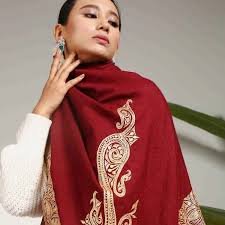
How Changthangi Goat Wool Creates a Weightless Cloud Feeling
To fully understand why a genuine shawl triggers such a distinct physical sensation, we have to travel up into the high-altitude ecosystem where this raw material begins its journey. The weightless cloud feeling of authentic Kashmiri luxury is an evolutionary marvel designed by nature.
Deep inside the remote Changthang plateau of Ladakh, sitting at altitudes crossing 14,000 feet, indigenous Changthangi goats face brutal winter storms where temperatures routinely drop below minus forty degrees Celsius. To survive this unforgiving climate, these specialized animals grow a secondary, ultra-fine protective undercoat of downy hair right next to their skin.
This underfleece is what master weavers call Pashm.
When spring arrives, nomadic herders manually comb out this delicate layer. The physical properties of this raw fiber explain its weightless texture:
1. The Microscopic Micron Count
A single strand of human hair averages around 75 microns in diameter. Standard commercial wool sits anywhere between 24 to 40 microns.
Authentic Changthangi pashm measures an astonishing 12 to 14 microns in thickness.
Because the individual fibers are so incredibly fine, millions of individual threads are required to form a single woven row. This creates a dense, protective matrix that is packed with micro-pockets of air, allowing the fabric to insulate your body effectively while remaining completely light and weightless.
2. The Absence of Structural Weight
Because the raw fibers are hollow and structurally light, a full-size, two-meter-long plain authentic shawl weighs less than half a pound (roughly 200 grams).
When you drape it over your shoulders, you don’t feel the heavy, oppressive downward pull associated with industrial woolen coats or heavy blankets. Instead, it rests on your skin like a gentle layer of warm mist—a feeling often described by textile collectors as the “weightless cloud sensation.”
3. The Handloom Architecture
Because these fragile 12-micron fibers would snap instantly under the high-tension mechanical pulling of modern industrial factory powerlooms, they must be spun onto wooden threads using a traditional spinning wheel (Charkha) and woven entirely by hand on old-school wooden looms.
When an artisan weaves by hand, their manual beat rhythm is naturally variable. If you hold a genuine shawl up against a bright window or a natural light source, you will see minor, charming variations in the weave structure—tiny, irregular gaps where the human hand adjusted the warp and weft.
These organic structural variations give the fabric an airy elasticity and breathability that no factory machine can ever replicate.
The Static and Friction Reality Test
If you are still sitting with your item and want to push beyond basic tactile intuition, you can perform a quick, harmless friction check right now.
Hold a section of the fabric firmly between your palms and rub the layers together briskly for ten seconds.
- The Synthetic Reaction (Acrylic/Polyester): If the piece contains hidden synthetic plastic components, the friction will instantly generate a crackling burst of static electricity. You might even hear tiny pops or feel the tiny surface fibers pulling and clinging tightly to the hairs on your arm.
- The Authentic Reality: Pure animal hair from the Changthangi goat cannot build up a high static charge. When rubbed against itself, it remains perfectly quiet, soft, and texturally neutral. It will, however, exhibit a very slight natural pill over time—tiny, soft fuzzballs that form on the surface due to the short staple length of hand-spun yarn. This pilling is not a defect; it is a clear signature of unblended, organic luxury.
Frequently Asked Questions (FAQs)
1. Is it true that a real Pashmina shawl must pass through a finger ring?
The classic “ring test” is an excellent historical indicator, but it shouldn’t be your only benchmark today. A finely woven, plain-solid, pure pashmina shawl can easily slide smoothly through a standard wedding ring because the fibers are incredibly fine and compressible. However, modern counterfeiters have learned to replicate this by using ultra-thin synthetic viscose or polyester filaments. Furthermore, if your authentic shawl features heavy Sozni hand-embroidery or thick Kani weaves, it will naturally bunch up and fail the ring test due to the added weight of the decorative threads, despite being 100% genuine.
2. Does real Pashmina have a shiny, glossy surface finish?
No, authentic pashmina has a soft, muted, and completely matte finish. It possesses a very subtle, natural organic luster when light catches the individual fibers, but it never looks highly glossy, reflective, or metallic. If a shawl has a loud, bright sheen to it, it has been heavily blended with cheap industrial mercerized cotton, rayon, or synthetic silk.
3. Why does my new Pashmina feel a bit stiff out of the box?
If you bought a certified piece directly from a trusted Kashmiri cooperative, it might feel slightly crisp initially. This is because traditional weavers often apply a natural, organic starch wash (made from boiled rice water) to protect the hyper-delicate hand-spun yarn from fraying or breaking while it is mounted on the wooden loom. Within just two or three wears, this temporary starch breaks down completely, and the fabric unlocks its signature cloud-like softness, becoming loftier and more luxurious with age.
See Also
How to Identify Pure Pashmina Shawl at Home: The Complete 6-Step Checklist
Pashmina – The Kashmiri Craft that has Survived Centuries | Stories That Matter