
If you come across a shawl described as papier mache embroidery pashmina, the name can be rather confusing. Is paper somehow attached to a Pashmina shawl? Is it painted? Is papier-mâché another name for Sozni?
The simple answer is no: papier-mâché embroidery on Pashmina does not contain paper.
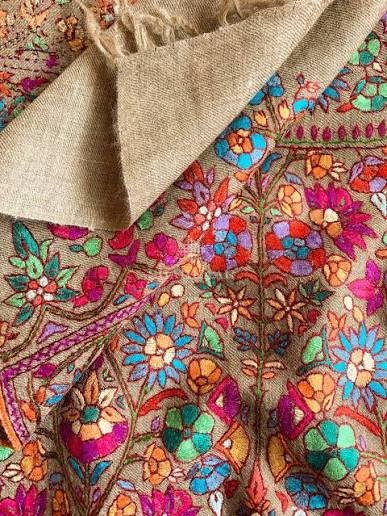
It is a colourful style of Kashmiri needle embroidery whose dense, outlined motifs visually recall the richly painted surface decoration of Kashmir’s famous papier-mâché objects. Compared with very fine Sozni work, the embroidery is generally bolder, more colourful and more pronounced.
The CBSE’s manual on Kashmiri embroidery describes Papier Mache embroidery as a bolder variant of Sozni, using brighter satin threads, thicker needle and thread, and outlining around completed motifs to make them stand out.
That difference is important when you are comparing embroidered Pashmina types or deciding whether the shawl in front of you is actually worth its asking price.
What Is Papier-Mâché Embroidery on Pashmina?
A papier mache Pashmina shawl begins with a woven shawl. The decorative pattern is then added with needle and thread.
In other words, the pattern is embroidered after the cloth has been woven.
This immediately separates papier-mâché embroidery from Kani weaving, where coloured yarns become part of the fabric during the actual weaving process.
Kashmiri papier mache embroidery is closely related technically to Sozni needlework. What gives it its individual character is its stronger use of colour, thicker-looking embroidery, filled motifs and sharply defined outlines.
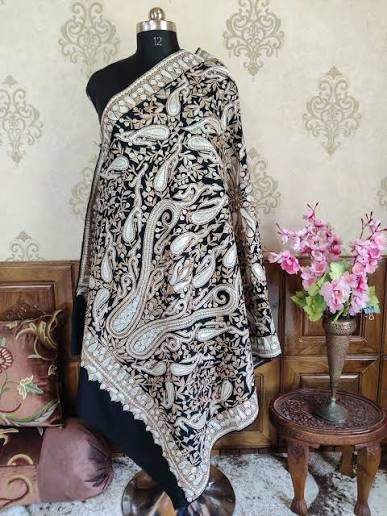
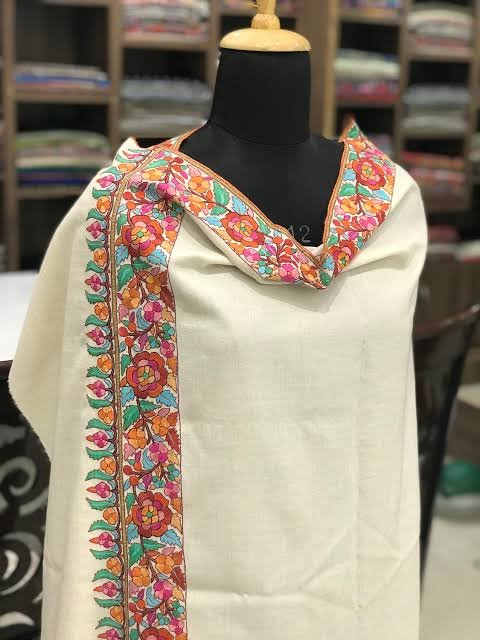
A typical piece may combine reds, blues, greens, pinks, oranges and gold-like shades, often against a comparatively restrained Pashmina ground. Flowers, leaves, vines and paisley-shaped forms can be packed closely together until the shawl begins to resemble a painted decorative surface.
That visual effect explains its unusual name.
Why Is It Called Papier-Mâché if No Paper Is Used?
Kashmir has a separate and famous papier-mâché tradition in which objects made using paper pulp are prepared, smoothed and then painted with elaborate ornamentation.
Government handicrafts documentation describes Kashmiri papier-mâché objects as using vivid reds, blues, whites and blacks, sometimes combined with yellow, gold and silver, with floral designs among their characteristic decorative forms. (Handicrafts)
Papier mache embroidery pashmina takes its name from the visual similarity between these painted surfaces and the embroidered textile.
The connection is therefore aesthetic rather than material.
Quick answer: Papier-mâché embroidery on Pashmina does not use paper. It is a colourful Kashmiri needlework style related to Sozni embroidery. Its densely filled and outlined floral motifs resemble the richly painted decoration seen on traditional Kashmiri papier-mâché objects.
This distinction is especially useful when shopping online, because product descriptions sometimes discuss “papier-mâché” without explaining whether they mean the actual paper craft or the embroidery style inspired by it.
How Kashmiri Papier Mache Embroidery Is Created
The broader production process is closely connected with that of Sozni.
A design first has to be planned and transferred to the cloth. In traditional Sozni production, a naqash or designer develops the pattern, which can then be transferred through carved blocks before an embroiderer begins filling the design by hand. Government documentation describes Sozni as a fine needlework tradition using several stitches, including Sozni, darn and stem stitches. (Handicrafts)
With papier mache embroidery pashmina, the embroidery is visually more assertive.
The CBSE description specifically notes thicker thread and needle use, bright satin thread and the outlining of motifs after they have been worked.
Look closely at a good piece and you will therefore often see two stages visually: the coloured body of a flower, leaf or paisley, followed by a darker or contrasting outline that separates it from the surrounding design.
The finished effect can look almost illustrated.
Colours and Motifs in Papier Mache Pashmina Shawls
Colour is one of the easiest ways to distinguish Kashmiri papier mache embroidery from especially restrained examples of Sozni.
Instead of working mainly with one or two closely related shades, papier-mâché designs frequently combine several contrasting colours within the same composition.
Common visual elements include:
- flowers and flowering vines;
- leaves and curling stems;
- paisley or buta forms;
- almond-like motifs;
- repeated floral sprays;
- scrolling borders; and
- densely interconnected botanical designs.
These motifs are not exclusive to papier-mâché embroidery. Kashmiri textile traditions share a considerable decorative vocabulary. Government information on Sozni, for example, records chinar, cypress, almond, grape, pomegranate, lotus, iris, daffodil, lily and rose among its design inspirations. (Handicrafts)
It is therefore usually the combination of motif, colour, density, thread and outlining that identifies the papier-mâché look rather than a single flower or paisley.
Papier Mache vs Sozni: What Is the Difference?
This is probably the most important distinction for buyers.
Both are needle embroidery traditions, and the boundary between them can sometimes be less rigid in commercial terminology than product listings suggest.
Official GI specifications describe Kashmir Sozni as extremely fine needlework whose stitches give the embroidery delicacy and considerable uniformity on both sides of the fabric. (Iict Srinagar Carpet GI)
Papier-mâché embroidery is generally understood as its bolder relative.
In practical terms, papier mache vs Sozni usually comes down to visual character.
Fine Sozni can look almost drawn onto the fabric. Papier-mâché work is more likely to announce itself through strong colours, filled surfaces and pronounced outlining.
This also explains why some sellers use expressions such as “papier-mâché Sozni”. The traditions are closely related rather than entirely disconnected crafts.
Papier-Mâché Embroidery vs Sozni vs Kani Weaving
| Feature | Papier-mâché embroidery | Sozni embroidery | Kani weaving |
|---|---|---|---|
| Method | Needle embroidery after weaving | Fine needle embroidery after weaving | Pattern created during weaving |
| Typical appearance | Dense, colourful and strongly outlined | Fine, delicate and refined | Multicoloured pattern integrated into cloth |
| Texture | Usually more pronounced | Usually finer and flatter | Pattern forms part of weave |
| Colour effect | Frequently bold and contrasting | Can be subtle or multicoloured | Multiple coloured weft yarns |
| Design process | Embroidered motifs | Embroidered motifs | Woven according to a talim |
| Typical appeal | Decorative statement shawls | Refined embroidered shawls | Highly elaborate woven shawls |
| How to identify | Look for individual stitches and outlined filled motifs | Look for exceptionally fine needlework | Look for pattern structurally woven into fabric |
The fundamental distinction with Kani is particularly clear. Official Kashmir GI specifications state that Kani shawls are handwoven using small eyeless wooden spokes known as kanis or tujlis. Different coloured wefts are interlocked according to written instructions called a talim. (Iict Srinagar Carpet GI)
So a Kani design is not embroidery placed on a completed plain shawl.
It is the weave itself.
How to Recognise Hand Papier-Mâché Embroidery
There is no single visual test that can authenticate an expensive shawl, particularly from an online photograph. Still, a close inspection can tell you quite a lot.
Turn the shawl over first.
With genuine hand embroidery, you should be able to follow the thread work on the reverse. Fine handwork generally shows the logic of individual stitches rather than a completely separate decorative layer glued or printed over the surface.
Next, examine repeated flowers and leaves.
Handmade motifs can be extremely precise, but tiny variations are normal. A curve may finish fractionally differently or an outline may vary slightly from one repeated motif to another.
Also look at the edges of colour changes. In good papier mache embroidery pashmina, these should resolve into actual stitches when viewed closely.
Do not, however, treat “imperfections” as proof of authenticity. Machine embroidery can also be deliberately designed to look handmade.
For an expensive purchase, provenance, material certification and seller documentation matter more than a viral home test.
Jaal, Border, Buti and Jama Design Variations
Another source of confusion is the vocabulary used to describe how much of a shawl is embroidered.
These terms generally refer to the placement or coverage of decoration, rather than changing papier-mâché into a different embroidery technique.
A buti design uses separate small motifs distributed across the shawl.
A border design concentrates embroidery around the edges and can give the shawl a rich appearance without covering its entire surface.
A jaal creates a network or spreading pattern across a larger part of the shawl.
A densely decorated jama or jamawar-style shawl may cover most or almost all of the visible surface with ornament.
Government documentation similarly records styles such as Jamawaar, Jaaldar, Butidaar and Palladar within the wider Sozni tradition. (Handicrafts)
This matters when comparing prices. A shawl with a narrow papier-mâché border should not be compared directly with an all-over embroidered piece simply because both product descriptions use the same embroidery name.
Why Dense Embroidery Makes a Pashmina Shawl Heavier
One of Pashmina’s attractions is its remarkable softness and relatively light feel.
Embroidery adds material.
A densely worked papier mache Pashmina shawl therefore contains far more thread than a plain shawl or lightly embroidered butidar piece. That extra thread adds weight and can also alter how freely the underlying Pashmina falls.
A heavily embroidered shawl may feel more structured across richly worked sections, while unembroidered areas retain the softer movement of the base fabric.
This is not necessarily a quality problem. It is simply part of the character of heavily embellished shawls.
What buyers should be cautious about is the assumption that “heavier” automatically means “better Pashmina”. Weight may come from embroidery, thicker base fabric or different fibre composition. It cannot establish authenticity by itself.
How Is the Price of Papier Mache Embroidery Pashmina Determined?
There is no standard price for papier mache embroidery pashmina because you are effectively paying for two things: the shawl and the work added to it.
Price can change according to the quality of the Pashmina base, amount of embroidery, fineness of the stitching, complexity of the pattern, number of colours, skill of the artisan and overall finishing.
Time is another major factor.
A relatively modest border naturally requires much less labour than an intricate all-over composition. Commercial examples document papier-mâché embroidered shawls requiring many months of work, while especially elaborate pieces may take considerably longer. These production times should be regarded as piece-specific rather than a fixed rule for the craft. (PASHMIRAH)
This is why a suspiciously cheap “fully hand-embroidered pure Pashmina” deserves additional questions.
Ask what the base fibre is, where it was woven, where it was embroidered and whether any certification accompanies the Pashmina claim.
Is Every Papier-Mâché Embroidered Shawl Pure Pashmina?
No.
This is one of the most useful things to understand before buying.
Papier-mâché describes the embroidery style. It does not automatically certify the fibre underneath it.
The technique can theoretically be applied to other suitable fabrics. So a wool, cashmere blend or other textile may carry papier-mâché-style embroidery without becoming genuine Kashmir Pashmina.
The GI specification for Kashmir Pashmina is much more specific: it describes 100% Pashm fibre up to 16 microns, handwoven by artisans of Jammu and Kashmir and made using hand-spun yarn. (Iict Srinagar Carpet GI)
So if a product is described as a “papier mache shawl”, check the fibre composition separately.
Another useful point: official GI listings recognise Kashmir Pashmina, Kashmir Sozni, Kani Shawl and Kashmir Paper Machie as distinct registered crafts. “Papier-mâché embroidery” itself should not be treated as a substitute for Pashmina certification. (Iict Srinagar Carpet GI)
How to Care for a Heavily Embroidered Pashmina
A richly embroidered shawl needs slightly more caution than an everyday woollen stole.
For an expensive papier mache embroidery pashmina, professional cleaning by a cleaner experienced with Pashmina and delicate embroidery is usually the safer choice.
Avoid ordinary machine washing, aggressive stain removers, wringing and hard rubbing.
When storing the shawl, make sure it is completely clean and dry. Fold it loosely rather than leaving the same crease in place for years, and store it in a breathable protective covering in a dry cupboard.
Keep perfumes, deodorants and cosmetics away from the embroidery where possible.
If ironing is necessary, avoid pressing a hot iron directly over raised needlework. The aim is to preserve both the delicate Pashmina underneath and the shape of the embroidery above it.
Papier Mache Embroidery Pashmina Buyer’s Authenticity Checklist
Before paying a premium for a shawl, check all three elements separately: the fibre, the construction and the embroidery.
- Check the fibre description. “Papier-mâché” tells you nothing by itself about whether the shawl is pure Pashmina.
- Ask whether the base shawl is handwoven. This becomes particularly important when the seller claims Kashmir Pashmina.
- Inspect the embroidery closely. Look for real needlework rather than printing or surface imitation.
- Examine the reverse. The back should reveal the construction of the embroidery.
- Ask how much is hand embroidered. Border, buti, jaal and full-coverage pieces involve very different amounts of labour.
- Do not confuse Kani with embroidery. Genuine Kani patterns are woven into the shawl.
- Ask about GI or quality certification for the Pashmina base. The Government-recognised Kashmir Pashmina GI has defined material and production specifications. (Iict Srinagar Carpet GI)
- Be cautious with vague labels. Terms such as “Kashmiri style”, “Pashmina feel” and “cashmere-like” are not the same thing as a documented Kashmir Pashmina shawl.
- Compare workmanship, not just weight. Heavy embroidery naturally increases weight.
- Buy provenance, not a story. For an expensive heirloom shawl, invoices, fibre information, certification and a credible seller are considerably more useful than burn tests or ring tests.
Frequently Asked Questions About Papier Mache Embroidery Pashmina
Does papier-mâché embroidery contain paper?
No. Papier mache embroidery pashmina contains no paper as part of the embroidery technique. The term comes from the visual resemblance between the colourful, outlined needlework and the painted decoration of traditional Kashmiri papier-mâché objects.
Is papier-mâché embroidery the same as Sozni?
Not exactly, although the two are closely related. Papier-mâché embroidery is commonly described as a bolder variation of Sozni. It typically uses thicker-looking threadwork, brighter colours and pronounced outlining, whereas very fine Sozni is known for delicate and highly refined needlework.
Is papier-mâché embroidery done by hand?
Traditional Kashmiri papier mache embroidery is hand needlework. However, the wording used on a product listing is not proof that a particular modern shawl is handmade. Buyers should check the workmanship and ask the seller specifically whether the embroidery is entirely hand executed.
Why are papier-mâché Pashmina shawls heavier?
Dense embroidery adds substantial thread to a light woven base. A full papier mache Pashmina shawl can therefore feel noticeably heavier and more structured than an unembroidered Pashmina or one with only a narrow border.
How long does papier-mâché embroidery take?
There is no standard number of days. A border may require far less labour than a densely embroidered shawl. Documented commercial examples range through many months and, for particularly elaborate pieces, longer. The complexity and coverage of the design matter more than the embroidery name alone. (PASHMIRAH)
Can papier-mâché embroidery be done on blended fabric?
Yes. The embroidery technique and the underlying fibre are separate questions. Papier-mâché-style needlework can be applied to fabrics other than pure Pashmina. But a blended shawl should not be represented as GI-specification Kashmir Pashmina, whose specification requires 100% Pashm fibre along with defined production methods. (Iict Srinagar Carpet GI)
Understanding Papier-Mâché Embroidery Before You Buy
Among the many embroidered Pashmina types, papier-mâché is one of the easiest to notice from across a room. It is colourful, dense and decorative, yet its roots lie in the same extraordinary Kashmiri environment that produced fine Sozni embroidery, Kani weaving and painted papier-mâché objects.
The easiest way to remember the distinction is this:
Sozni is known for finesse. Papier-mâché embroidery emphasises colour and definition. Kani creates the design through weaving rather than embroidery.
And when shopping for a papier mache embroidery pashmina, always separate the questions of design and material. A beautiful embroidery style does not by itself prove that the cloth underneath is pure Pashmina.
That small piece of knowledge can make the difference between buying a decorative shawl and understanding exactly what you are paying for.
See Also
- Pure pashmina shawl | shawls | sozni work | handmade shawl | papier-mâché | kashmiri shawl
- Handembroidered pashmina shawl with papier mache embroidery
- What Is Tilla Embroidery Pashmina? Craft, Motifs and Buying Guide
- The Journey of Raw Pashm: How Is Kashmiri Pashmina Made Step by Step?
- Kani Weave vs Sozni Embroidery Pashmina: The Ultimate Heritage Guide
- What Does Real Kashmiri Pashmina Feel Like? Tactile Identity Guide