
Buying a real Pashmina shawl in India can feel confusing. One shop says “pure Pashmina”, another says “Kashmiri cashmere”, another says “semi-Pashmina”, and online listings often use words like “soft wool”, “cashmere feel”, “Ladakhi weave” or “100% original” very casually. To the normal buyer, many shawls look almost the same. They feel soft, they drape well, and they may even pass the basic touch test.
But here is the truth: human eyes alone can fail against premium modern replicas.
That is why serious brands, exporters, museums, textile labs and quality-control teams do not depend only on touch, burn tests or shopkeeper promises. They use microscopes, fibre diameter machines, animal-species tests and sometimes protein or DNA-based methods. If you really want to understand how to test pashmina fiber purity, you need to enter the world of textile laboratories.
This guide explains how professional labs identify fake cashmere and how they separate real Ladakhi Pashm from ordinary sheep wool, fine merino wool, yak blends, synthetic fibre and mixed “cashmere-like” fabrics.
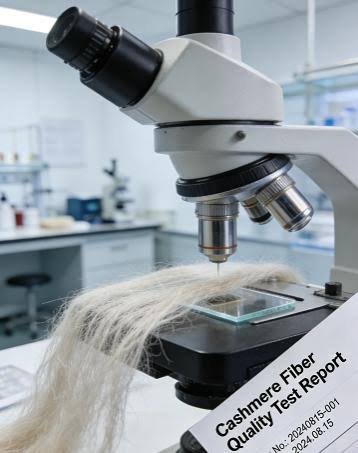
Quick Answer: How Do Labs Test Pashmina Fiber Purity?
If you want a simple step-by-step answer on how to test pashmina fiber purity, here is the professional checklist.
Labs usually check three major things:
- Microscopic scale structure
Under a light microscope or scanning electron microscope, animal fibres show tiny surface scales. Cashmere, Pashmina and wool may look similar to the naked eye, but their scale height, scale edge, surface pattern and medulla structure can be different. - Average micron count and fibre diameter variation
Real fine Pashmina is extremely thin. Labs measure the fibre diameter in microns and study the average diameter, variation around the mean, and the percentage of coarse fibres. - Animal species confirmation using DNA or protein analysis
Advanced labs may use DNA-based species testing or protein mass spectrometry to confirm whether the fibre came from goat, sheep, yak or another animal source.
In short, the lab answer to how to test pashmina fiber purity is: look at the fibre, measure the fibre, and match the biological origin.
Why Fake Cashmere Is So Hard to Identify by Eye
Earlier, fake Pashmina was often easier to detect. A shawl might be too shiny, too thick, too rough, too heavy, or clearly synthetic. But today’s premium replicas are far more advanced.
Modern fake cashmere can be made using:
- Fine merino wool
- Blended sheep wool
- Viscose
- Acrylic
- Silk-wool blends
- Yak wool blends
- Low-grade cashmere mixed with cheaper fibres
- Chemically softened wool
Many of these fabrics feel soft at first touch. Some even become softer after finishing treatments. This is why a buyer in Delhi, Srinagar, Jaipur, Mumbai or Bengaluru may struggle to tell the difference in a showroom.
The problem is not that buyers are careless. The problem is that fibre fraud has become sophisticated. That is exactly why knowing how to test pashmina fiber purity matters.
What Is Pashmina Fibre, Actually?
Before we talk about lab tests, let us clear the basics.
Pashmina is a very fine animal fibre traditionally obtained from the undercoat of the Changthangi goat, found in the high-altitude regions of Ladakh. The word “Pashm” refers to the soft under-fleece. This fine fibre is collected, cleaned, dehaired, spun and woven into shawls, stoles and scarves.
All Pashmina is a type of fine cashmere, but not all cashmere is Pashmina. Cashmere can come from different goat breeds and regions across the world, including Mongolia, China, Iran, Afghanistan, Nepal and India. Ladakhi Pashm has its own cultural, geographic and technical identity.
So, when someone asks how to test pashmina fiber purity, they are usually asking two questions:
- Is the fabric really made from fine goat undercoat?
- Is it pure Pashmina, or is it mixed with wool, silk, viscose or synthetic fibre?
A lab tries to answer both.
Test 1: Microscopic Scale Structure
The first professional method in how to test pashmina fiber purity is microscopic analysis.
Animal hair fibres are not smooth rods. Under magnification, they have tiny overlapping scales on the surface, a bit like roof tiles or fish scales. These scales are part of the cuticle layer.
A trained textile analyst studies:
- Scale pattern
- Scale height
- Scale edge shape
- Scale spacing
- Fibre diameter
- Medulla presence or absence
- Surface damage
- Pigmentation
- Shape consistency
This is where fake cashmere starts getting exposed.
Pashmina vs Wool Under Microscope
Sheep wool and Pashmina can both show scale patterns, but they are not identical. Wool often has a more prominent scale structure, and some wool fibres may be thicker or more medullated. Fine merino wool can be closer to cashmere in softness, which is why it is often used in premium blends. But under magnification, trained analysts can still identify important differences.
The challenge is that one fibre alone may not prove everything. Labs examine many fibres from different parts of the shawl. A fake product may contain 70% wool and 30% cashmere, or 90% wool with a little cashmere added for softness. That is why professional testing is statistical, not emotional.
A proper lab does not say, “This feels like Pashmina.” It says, “Out of the examined fibres, this percentage matched cashmere/Pashmina characteristics.”
Test 2: Scanning Electron Microscope Analysis
The next advanced answer to how to test pashmina fiber purity is SEM testing, or scanning electron microscopy.
A scanning electron microscope gives highly detailed images of the fibre surface. Compared to a normal light microscope, SEM can show the scale structure with greater depth and clarity.
Labs use SEM to study:
- Fine surface scale details
- Scale thickness
- Scale edge morphology
- Fibre surface damage
- Differences between cashmere and wool
- Unusual synthetic or regenerated fibres
- Suspicious fibre blends
For high-value Pashmina shawls, SEM is especially useful when the sample is very fine and the replica is very good. If ordinary light microscopy gives unclear results, SEM can provide a sharper view.
Why Scale Structure Matters
The scale structure is like a fingerprint, but not a perfect fingerprint. It helps identify the fibre family, but it must be combined with diameter testing and other methods. A lab will not rely only on one image and declare a ₹50,000 shawl genuine.
That is the big lesson in how to test pashmina fiber purity: one test is helpful, but multiple tests are stronger.
Test 3: Fibre Diameter and Micron Count
Now we come to the most famous metric: micron count.
A micron is one-millionth of a metre. In luxury textiles, smaller micron count usually means finer, softer fibre. Real Pashmina is famous because it is extremely fine. Many scientific and industry references describe Changthangi Pashmina as being around the low-teens micron range, often finer than ordinary cashmere.
When labs test fibre diameter, they look at:
- Average fibre diameter
- Fibre diameter distribution
- Coefficient of variation
- Percentage of coarse fibres
- Presence of guard hair
- Consistency across the fabric
This is one of the strongest parts of how to test pashmina fiber purity.
Why Average Micron Count Alone Is Not Enough
Suppose a sample has an average diameter of 15 microns. That sounds excellent. But what if half the fibres are 11 microns and the other half are 25 microns? The average may look fine, but the fabric may still be a blend.
That is why labs do not look only at one number. They look at the spread of the fibre diameter. A pure luxury fibre should show a more consistent fine-fibre profile. A blend may show two or more clusters: very fine fibres mixed with thicker wool fibres.
This is where high-precision fibre diameter machines help.
How Machines Measure Fibre Diameter
Professional labs may use instruments such as projection microscopes, Optical Fibre Diameter Analysers, laser-based systems or automated image analysis tools. The exact machine depends on the lab, the standard followed and the sample type.
The basic process looks like this:
- A small sample is taken from the shawl or yarn.
- Fibres are cleaned and prepared.
- Short snippets are mounted for testing.
- The machine captures fibre images or optical readings.
- Software calculates mean fibre diameter and distribution.
- The lab compares results with known fibre standards.
This gives a more objective answer to how to test pashmina fiber purity than a shop-level touch test.
Mongolian Cashmere vs Ladakhi Pashm vs Fine Merino Wool
Now let us understand the deeper technical difference.
Mongolian Cashmere
Mongolian cashmere is globally respected and widely used in luxury fashion. It comes from cashmere goats adapted to cold climates. Good Mongolian cashmere is fine, warm and soft. Its micron count can be very low, though commercial grades vary widely.
Ladakhi Pashm
Ladakhi Pashm from Changthangi goats is prized for extreme fineness, warmth and heritage value. The goats live in harsh high-altitude conditions, and the undercoat they grow is exceptionally fine. When hand-spun and handwoven, this fibre creates the classic soft yet warm Pashmina feel.
Fine Merino Wool
Fine merino wool can also be very soft. Some superfine merino can come close to cashmere in diameter. This is why merino is sometimes used in cashmere-like shawls. To a casual buyer, a good merino shawl may feel luxurious.
But merino is sheep wool, not goat Pashmina. The difference matters for price, authenticity and labelling.
So, how to test pashmina fiber purity when all three can be soft? Labs combine micron count, microscopy and animal-origin testing. Softness alone is never enough.
Test 4: Animal Species DNA Matching
Another advanced method in how to test pashmina fiber purity is animal species testing.
Because Pashmina comes from goats, not sheep, labs may test whether the animal origin matches goat fibre. DNA-based methods can help detect whether the sample contains goat, sheep, yak or other animal material.
However, there is one important limitation: finished textile fibres may contain very little usable DNA because of washing, dyeing, scouring and processing. That means DNA tests are often more useful for qualitative species identification than precise percentage calculation.
In simple words, DNA may help answer: “Is goat fibre present?” But it may not always give the full blend percentage with perfect accuracy.
Test 5: Protein or Keratin Matching
Modern labs may also use protein-based methods. Animal fibres are made largely of keratin proteins. Different animal species can have slightly different protein signatures. Techniques such as mass spectrometry can detect peptide patterns linked to particular animal fibres.
This is becoming important because cashmere, wool, yak and other animal fibres can be difficult to separate by eye. Protein analysis gives a more objective biological confirmation.
For shoppers trying to understand how to test pashmina fiber purity, the simple explanation is this: the microscope looks at the fibre shape, while protein testing checks the biological identity.
Test 6: Blend Percentage Analysis
Many fake or misleading Pashmina products are not fully fake. They may contain some real cashmere or Pashmina mixed with wool, silk, viscose or synthetic fibres.
For example:
- 20% cashmere + 80% wool
- 50% wool + 50% viscose
- 70% fine merino + 30% cashmere
- 60% Pashmina + 40% silk
- 100% acrylic sold as “cashmere feel”
A lab can test the fibre composition and estimate the percentage of different fibres. This is important because a shawl labelled “100% Pashmina” should not be a vague blend.
This is why how to test pashmina fiber purity is not only about finding whether Pashmina exists. It is also about checking how much is actually present.
Why the Burn Test Is Not Enough
Many Indian shoppers have heard of the burn test. The idea is that natural animal fibre smells like burnt hair, while synthetic fibre melts or smells like plastic.
This test may give a rough clue, but it is not enough.
Why?
Because wool, cashmere and Pashmina are all animal fibres. They may all smell similar when burnt. A wool shawl can pass the burnt-hair smell test and still not be pure Pashmina. A wool-cashmere blend may also confuse the result.
Also, burning a luxury shawl is not exactly practical.
So, when people ask how to test pashmina fiber purity, the burn test should be seen only as a basic home clue, not a professional proof.
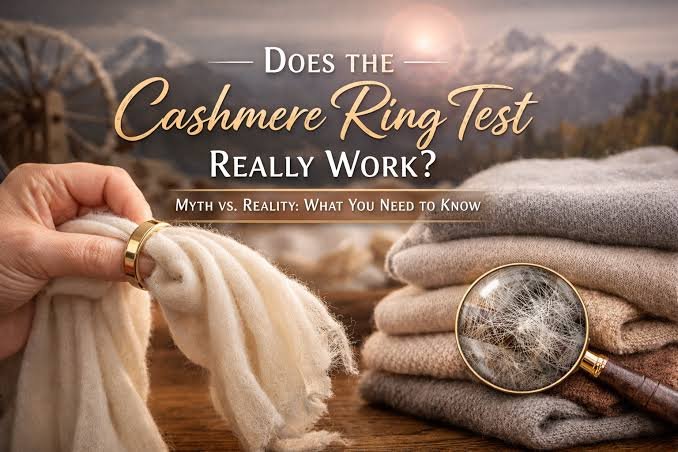
Why the Ring Test Is Also Misleading
Another popular myth is that a real Pashmina shawl should pass through a finger ring. This is not a reliable purity test.
A very fine silk shawl may pass through a ring. A thin viscose blend may pass too. A genuine handwoven Pashmina with embroidery may not pass because embroidery adds thickness. A thicker winter Pashmina may also fail the ring test.
The ring test tells you about thinness and drape. It does not prove fibre purity.
A lab does not use the ring test. A lab uses microscopes, micron machines and biological analysis.
What a Professional Pashmina Lab Report May Include
A good textile lab report may include:
- Sample description
- Test method used
- Fibre composition percentage
- Mean fibre diameter
- Diameter range
- Fibre scale observations
- Microscopic images
- Detection of wool, cashmere, silk, viscose or synthetic fibres
- Remarks on sample limitations
- Date, lab name and authorised signatory
If you are buying high-value Pashmina for resale, export, gifting or collection, asking for a credible lab report is reasonable.
This is the most serious answer to how to test pashmina fiber purity: get documented testing from a proper textile laboratory.
Can a Buyer Test Pashmina Purity at Home?
At home, you cannot test Pashmina purity with lab-level accuracy. But you can reduce your risk.
Use this buyer checklist:
- Check if the seller clearly says “100% Pashmina” or uses vague words.
- Ask whether the shawl is handwoven, machine-made or blended.
- Look for GI-related authenticity details where applicable.
- Ask for a lab test certificate for high-value purchases.
- Avoid listings that say “cashmere feel” but imply pure Pashmina.
- Be suspicious of very cheap “pure Pashmina” shawls.
- Check return policy before buying online.
- Prefer sellers who explain fibre source and testing.
This will not replace a lab, but it will help you shop smarter.
Red Flags of Fake or Misleading Pashmina
Watch out for these signs:
- “Pure Pashmina” at an unrealistically low price
- No fibre composition label
- No seller transparency
- Too much artificial shine
- Very heavy fabric sold as ultra-fine Pashmina
- Vague terms like “Pashmina touch”
- No mention of wool, silk or synthetic blend
- Machine-made shawls sold as hand-spun handwoven Pashmina
- No certificate for premium pricing
Again, the only reliable way to settle doubt is to understand how to test pashmina fiber purity through professional analysis.
Why Lab Testing Protects Indian Buyers and Artisans
Fake Pashmina does not only cheat buyers. It also hurts real artisans, herders, spinners, weavers and small businesses connected to the Pashmina value chain.
When fake products flood the market, genuine handmade Pashmina looks “expensive” by comparison. Customers start bargaining unfairly because they have seen cheap machine-made alternatives online. Over time, this damages trust in the whole category.
Proper testing protects:
- Buyers
- Artisans
- Ethical brands
- Exporters
- Local heritage
- Serious collectors
- Honest retailers
So, how to test pashmina fiber purity is not just a technical question. It is also a fairness question.
Final Thoughts: Real Pashmina Cannot Be Judged by Touch Alone
A real Pashmina shawl is not just soft. It is a fine animal fibre with a particular source, structure, diameter and making process. Modern replicas can imitate softness, drape and appearance, but they cannot easily hide under a microscope.
If you want to know how to test pashmina fiber purity, remember the three most important lab checks:
- Surface scale structure under microscopy
- Micron count and fibre diameter distribution
- Animal-origin confirmation through DNA or protein-based testing
For normal shoppers, this means one thing: do not depend only on touch, price or shopkeeper claims. For expensive purchases, ask for proof. For business purchases, insist on lab reports. For heritage Pashmina, respect the science behind the softness.
Real Pashmina is beautiful, but under the microscope, it is also measurable.
FAQs: How to Test Pashmina Fiber Purity
1. How do labs test Pashmina fiber purity?
Labs test Pashmina fibre purity using microscopy, fibre diameter measurement, SEM images, blend analysis and sometimes DNA or protein-based species identification.
2. Can I test Pashmina purity at home?
You can do basic checks at home, but you cannot confirm purity accurately. Touch, ring test and burn test are not enough to prove real Pashmina.
3. What is the best professional method to detect fake cashmere?
The best approach is a combination of microscopy, micron count testing and animal-origin confirmation. One test alone may not be enough.
4. Is the burn test reliable for Pashmina?
No. The burn test can only roughly separate animal fibre from synthetic fibre. It cannot reliably separate Pashmina from sheep wool or merino wool.
5. What micron count is expected in fine Pashmina?
Fine Ladakhi Pashm is commonly described in the low micron range, often around 11–13 microns in scientific and industry references. Commercial cashmere quality varies by source and grade.
6. Can merino wool feel like Pashmina?
Yes. Fine merino wool can feel soft and luxurious, but it is sheep wool, not goat Pashmina. A lab can separate them using microscopy and biological testing.
7. What is SEM testing for Pashmina?
SEM stands for scanning electron microscopy. It gives detailed images of fibre surface scales and helps labs distinguish cashmere, wool and other specialty animal fibres.
8. Can DNA testing prove pure Pashmina?
DNA testing can help confirm animal species, such as goat versus sheep, but processed textiles may have limited usable DNA. Protein-based testing can also support fibre identification.
9. Why are fake Pashmina shawls common?
Fake Pashmina exists because real Pashmina is expensive, labour-intensive and highly valued. Cheaper wool, viscose, acrylic or blends are often marketed using similar words.
10. What should I ask before buying expensive Pashmina?
Ask for fibre composition, source, weaving method, GI or authenticity details, and a credible lab test report if the shawl is high-value.
The Viscose vs. Pashmina Showdown: Don’t Get Fooled by a Shiny Fake!
The BEST way to identify fake cashmere!