
A Kashmiri Pashmina shawl is already special. It is soft, warm, light, and elegant in that quiet way Indian winter luxury often is. But when a simple needle enters the picture, the shawl changes completely. It becomes more than clothing. It becomes an heirloom, a collector’s piece, and in many cases, a work of art that can take months to complete.
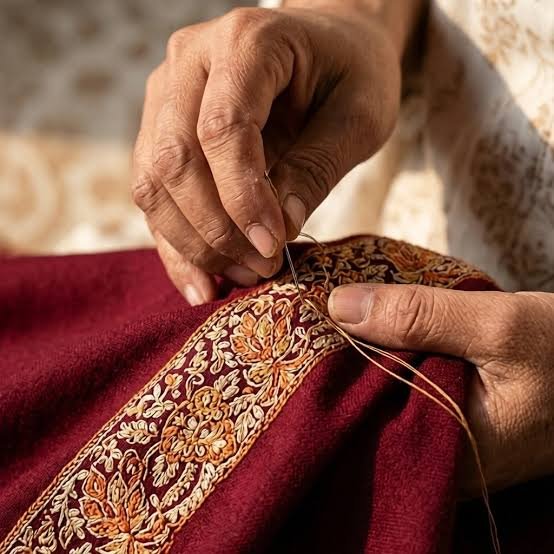
That is where the history of Kashmiri Sozni embroidery becomes so fascinating.
Sozni is not loud embroidery. It does not shout with heavy zari or chunky threadwork. It whispers. It sits delicately on the surface of a shawl, almost like a painting made with thread. The stitches are tiny, the motifs are graceful, and the final look is refined rather than flashy. This is exactly why Sozni embroidery has remained one of the most respected forms of Kashmiri needlework.
For Indian buyers, especially those looking for authentic Pashmina shawls, understanding the history of Kashmiri Sozni embroidery is not just a cultural lesson. It is also a practical buying guide. Once you know how much time, skill, and heritage goes into a real Sozni Pashmina shawl, you understand why genuine pieces cost more and why machine-made copies can never carry the same value.
What Is Kashmiri Sozni Embroidery?
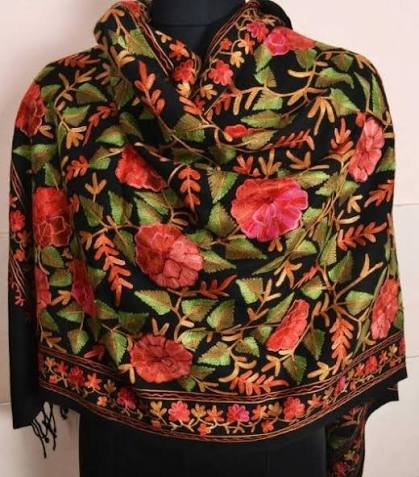
Kashmiri Sozni embroidery is a fine needle-based hand embroidery tradition from Jammu & Kashmir, usually done on Pashmina and other delicate textiles with silk or fine yarn. It is known for minute flat stitches, floral and paisley-inspired motifs, Persianate design influence, and highly detailed manual workmanship. True Sozni work is created by skilled artisans, traditionally called Sozankars, using fine needles to build elegant motifs such as Badam, Chinar, flowers, vines, borders, jaali patterns, and Jamawar-style all-over designs.
The official Geographical Indication documentation for Kashmir Sozani Craft describes it as fine needle work using Sozani, darn and stem stitches, with other stitches such as satin, chain, herringbone and knot stitches used in limited ways. It also notes that Sozni is minute, skill-intensive work with motifs drawn from Kashmir’s flora and fauna, including Chinar, almond, grapes, pomegranate, iris, lotus, lily and rose.
Why Sozni Made Kashmiri Shawls Feel Like Luxury Currency
Long before luxury brands, airport boutiques, and Instagram styling reels, Kashmiri shawls were already famous across courts, trade routes, and elite wardrobes. The finest shawls were not just bought for warmth. They were gifted, inherited, displayed, and treasured.
By the late eighteenth century, Cashmere-style shawls from India had become fashionable in Britain, and British manufacturers later began producing imitations that came to be known as Paisley shawls. (Victoria and Albert Museum) This tells us something important: the world did not simply admire the Kashmir shawl; it tried to copy it.
Sozni embroidery added another layer of value to this already prized textile. A plain Pashmina could show the beauty of the fibre. A woven shawl could show the skill of the loom. But a Sozni Pashmina shawl showed the patience of the human hand. Every tiny stitch made the shawl more personal, more rare, and more luxurious.
That is the heart of the history of Kashmiri Sozni embroidery. It is the story of how needlework transformed a soft Himalayan textile into a symbol of refinement.
Key Traits of True Sozni Embroidery
If you are buying a Pashmina shawl in India, especially online, you will see many products described as “Sozni work”. But true Sozni has some clear characteristics.
1. Microscopic Fine Needlework
The first thing to notice is the scale of the stitch. Real Kashmiri Sozni embroidery is extremely fine. The threadwork is delicate, controlled, and often so compact that the design looks almost printed from a distance.
The official GI description highlights the use of minute Sozani stitches laid as flat as possible against the fabric, creating strength, durability, and delicacy in the embroidery.
2. Flat, Smooth Surface
Unlike raised embroidery, Sozni usually sits flat on the shawl. This is one reason it looks so elegant on Pashmina. The embroidery does not overpower the fabric. Instead, it respects the softness and fall of the shawl.
This flatness also makes Sozni different from Aari work, which is usually done with a hooked needle and has a more chain-stitch look. Sozni is slower, finer, and more understated.
3. Persian and Mughal-Inspired Motifs
The history of Kashmiri Sozni embroidery is closely tied to Kashmir’s long artistic exchanges with Persia, Central Asia, and the Mughal world. Many traditional designs show floral symmetry, curling vines, paisley-like forms, cypress trees, almond shapes, and garden-inspired layouts.
The influence is visible not only in the motifs but also in the overall mood: balanced, refined, and poetic.
4. Months of Manual Focus
A simple border may take weeks or months. A heavy all-over Sozni shawl may take much longer depending on the density of work. The process is slow because the artisan cannot rush the stitch. On a fine Pashmina base, one wrong pull can disturb the fabric.
This is why a real Sozni Pashmina shawl is not just priced for material. It is priced for time.
The Origins of Sozni: A Craft Shaped by Kashmir’s Cultural Crossroads
The exact origin story of Sozni is layered. Some craft histories connect Sozni with Central Asian and Persian artistic influences that entered Kashmir through trade, migration, and spiritual-cultural exchange. Other accounts emphasise Mughal-era patronage, when Kashmiri shawls became prized courtly textiles.
Instead of seeing these as completely separate stories, it is better to understand Sozni as a craft shaped over centuries. Kashmir has always been a meeting point of mountain routes, Persianate aesthetics, Islamic art, local nature worship, and Indian textile genius. Sozni grew in this environment.
The history of Kashmiri Sozni embroidery is therefore not a single-date story. It is a living tradition refined by generations of artisans. Fathers taught sons, ustads trained apprentices, and families carried patterns, stitch discipline, and colour sense across time.
This is also why Sozni feels so rooted. It is not a trend that appeared suddenly. It is a slow craft tradition that has survived because it continues to produce beauty people can feel.
The Sozankar: The Artisan Behind the Shawl
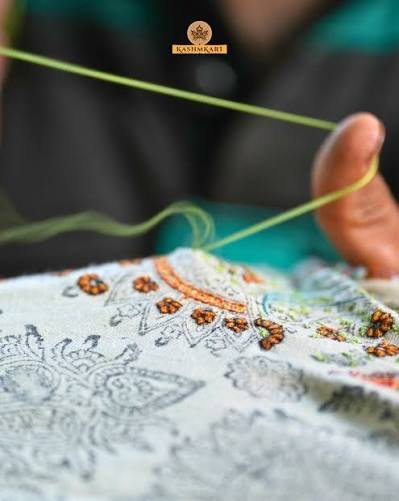
The person who practices Sozni embroidery is traditionally called a Sozankar. This word matters because it reminds us that the shawl is not made by a machine or anonymous factory process. It is made by a trained human being with a needle, thread, eyesight, posture, patience, and memory.
The artisan first understands the design. The pattern is transferred or traced onto the fabric. Then the stitching begins. The work may move from borders to motifs, from outlines to filling, from one colour tone to another. Finally, the embroidered shawl is washed and pressed using traditional finishing methods to bring out lustre and softness. The GI documentation also describes this process of tracing, filling with minute stitches, outlining motifs, washing, and pressing.
For the buyer, this is important. When you buy a genuine Sozni Pashmina shawl, you are not only buying wool and thread. You are paying for the focus of the Sozankar.
Badam: The Paisley Soul of Kashmiri Sozni Embroidery
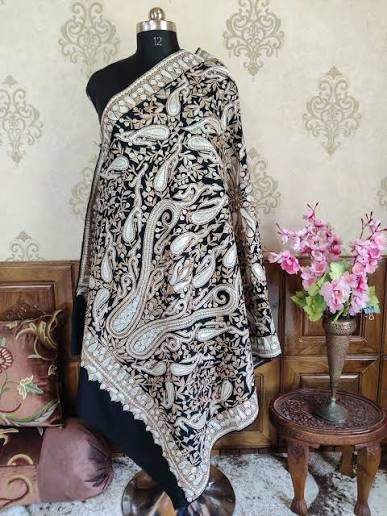
One of the most loved motifs in the history of Kashmiri Sozni embroidery is the Badam, or almond motif. Many Indian buyers also recognise it as the paisley or buta shape.
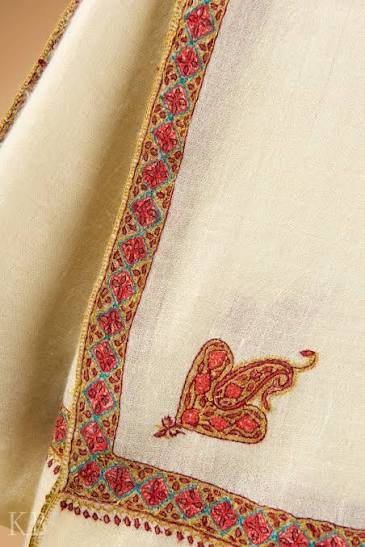
In Kashmiri textile language, the almond-like motif with a curved tip is everywhere. It appears in borders, corners, pallus, and all-over shawl designs. The GI documentation identifies the buti as a dominant motif in Sozani embroidery, describing it as a floral or almond motif with a bent tip.
Why does this motif matter so much? Because it connects Kashmir to the larger history of paisley. What many people now call “paisley” in global fashion has roots in Indian and Persianate buta forms. In Kashmir, it became softer, more floral, more intricate, and eventually iconic.
On a Sozni shawl, Badam may look small and delicate, or large and dramatic. A corner almond motif is also called Kunj, where a large almond form is placed at the corner facing towards the centre.
Shah Pasand: The Royal Taste in Thread
Another historically significant design name is Shah Pasand, often understood as “the emperor’s choice” or “the king’s favourite”. The very name gives us a clue about the world in which these designs matured: courts, nobility, patronage, taste, and prestige.
Craft narratives often link motifs such as Shah Pasand and Buta Mohammad Shah with Mughal influence on Kashmiri shawls. (Pashmina.com) These names are not random. They show how shawl designs carried memory. A motif could mark a period, a patron, a courtly preference, or an aesthetic language.
For today’s buyer, Shah Pasand is not just a pattern name. It is a reminder that Kashmiri shawls were once part of a world where textiles represented status, diplomacy, gifting, and cultural sophistication.
Jamawar and Jama: When the Whole Shawl Becomes a Garden
If border Sozni is elegant, full Jamawar-style Sozni is majestic.
The word Jamawar is often associated with richly patterned shawls where the design covers most or all of the surface. In Sozni embroidery, this idea appears in dense all-over work where the base fabric is almost hidden under fine stitches. The GI documentation describes “Jama” as a highly intricate Sozani embroidery style filled so closely with fine stitches that the ground fabric is barely visible.
This is the kind of shawl that makes people stop and stare.
A Jamawar-style Sozni Pashmina is not for someone looking for a casual winter wrap. It is for someone who understands heritage luxury. It may be worn at weddings, formal winter gatherings, family functions, or preserved as an heirloom.
In Indian homes, such shawls often become part of family memory. They are taken out carefully, shown to daughters and daughters-in-law, wrapped in muslin, and stored like jewellery.
Jaali, Buti, Border and Palla: Understanding Sozni Layouts
To appreciate the history of Kashmiri Sozni embroidery, it helps to understand common layout styles.
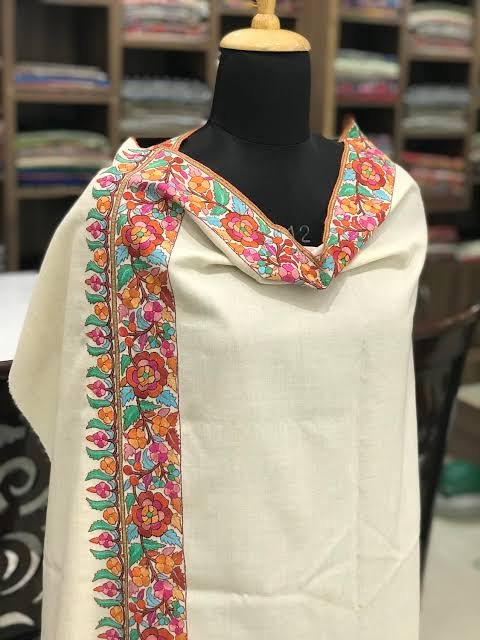
A border Sozni shawl has embroidery along the edges. This is ideal for people who want elegance without too much heaviness.
A butidar shawl has small motifs repeated across the body. These butis may be floral, almond-shaped, or inspired by leaves and vines.
A jaali design creates a net-like all-over pattern, sometimes in straight, criss-cross or wave-like arrangements with floral butis. The GI documentation specifically mentions jaali as a net-like embroidered pattern covering the fabric.
A palla or palledar shawl gives more importance to the end panels of the shawl. This is popular because the embroidery shows beautifully when draped over the shoulder.
A Jamawar or Jama style is the most elaborate, where fine stitches fill the shawl densely.
Each layout changes the price, time, and visual impact of the shawl.
Why Sozni Still Defines Luxury Value Today
In today’s market, buyers have many options: printed shawls, machine embroidery, wool blends, acrylic stoles, and mass-produced “Kashmiri-style” pieces. But genuine Sozni remains different.
First, it is handmade. That alone gives it scarcity.
Second, it is linked to place. Kashmir Sozani Craft is registered as a Geographical Indication in India. IP India lists Kashmir Sozani Craft as a registered GI, with Certificate Number 98 and registration currently valid up to January 2036. (IP India)
Third, it is deeply skilled. Not every embroiderer can do fine Sozni. It requires training, hand control, eye discipline, design understanding, and patience.
Fourth, it ages beautifully. A genuine Sozni Pashmina shawl, if cared for properly, can remain in the family for decades.
That is why the history of Kashmiri Sozni embroidery continues to matter. The history is not locked in museums. It is alive every time an artisan bends over a shawl and begins another line of stitches.
How to Identify a Genuine Sozni Pashmina Shawl
Here are a few practical points for Indian buyers.
Look closely at the stitch. Real Sozni will not look bulky. The thread should sit neatly and flat.
Check the reverse side. Hand embroidery usually has signs of human work. It should not look like a perfect machine copy.
Ask about the base fabric. A Sozni Pashmina shawl should clearly mention whether it is pure Pashmina, wool, silk, or another fabric.
Look for traditional motifs. Badam, Chinar, floral vines, pomegranate, cypress, jaali, kunj and buti patterns are all part of the Kashmiri design vocabulary.
Ask for authenticity details. For high-value pieces, check whether the seller provides GI, artisan, or authenticity information.
Avoid prices that look too good to be true. A heavily embroidered real Sozni Pashmina cannot be extremely cheap because the work itself takes serious time.
Caring for a Sozni Pashmina Shawl
A Sozni shawl should be treated gently. Do not wash it at home like a regular stole. Dry clean it through a trusted cleaner who understands delicate wool and embroidery.
Store it folded in breathable muslin or cotton. Avoid plastic for long-term storage because the fabric needs to breathe. Keep it away from direct sunlight, moisture, perfume, and naphthalene touching the fabric directly.
Every few months, take it out, refold it differently, and let it air in shade. This helps avoid permanent crease lines and keeps the shawl fresh.
A real Sozni Pashmina is not a throwaway fashion item. It is closer to jewellery. Wear it, enjoy it, but care for it.
Conclusion: The Needle That Carries Kashmir’s Memory
The history of Kashmiri Sozni embroidery is the story of a small needle doing something extraordinary. With thread, patience, and imagination, Kashmiri artisans transformed soft shawls into luxury objects admired across generations.
From Badam motifs to Shah Pasand designs, from delicate borders to magnificent Jamawar formats, Sozni embroidery carries Kashmir’s gardens, courtly histories, Persianate influences, and family traditions in every stitch.
For Indian buyers, owning a Sozni Pashmina shawl is not just about winter styling. It is about recognising handmade value. It is about choosing slow luxury over fast fashion. Most importantly, it is about respecting the Sozankar whose months of quiet focus make the shawl what it is.
So the next time you see a fine hand embroidered Pashmina, look closer. Behind that tiny stitch is a long history, a skilled hand, and the timeless beauty of Kashmir.
FAQs on the History of Kashmiri Sozni Embroidery
What is Sozni embroidery?
Sozni embroidery is a fine needle-based hand embroidery tradition from Kashmir. It is usually done on Pashmina, wool, silk, and other delicate fabrics using tiny flat stitches and traditional motifs such as Badam, Chinar, flowers, vines and paisley-style butas.
Why is Kashmiri Sozni embroidery expensive?
Kashmiri Sozni embroidery is expensive because it is completely hand-done, highly detailed, and time-consuming. A fine Sozni Pashmina shawl may take months depending on the density of embroidery, quality of fabric, and complexity of the design.
What is the difference between Sozni and Aari embroidery?
Sozni uses fine needlework and usually creates a flat, delicate surface. Aari embroidery uses a hooked needle and often creates chain-stitch-style patterns. Sozni is generally finer, slower, and more understated, while Aari is comparatively faster and bolder.
What are common motifs in Sozni embroidery?
Common Sozni motifs include Badam or almond paisley, Chinar leaf, cypress, pomegranate, grapes, iris, lotus, rose, floral butis, jaali patterns, kunj corner motifs, and Jamawar-style all-over layouts.
Is Sozni embroidery GI tagged?
Yes. Kashmir Sozani Craft is listed as a registered Geographical Indication in India by Intellectual Property India, with its certificate issued in 2008 and registration currently valid up to January 2036. (IP India)
See Also
Sozni Embroidery of Kashmir: A Stitch-by-Stitch Journey
Sozni Embroidery: A Guide to Kashmir’s Needle Art
The Journey of Raw Pashm: How Is Kashmiri Pashmina Made Step by Step?
Kani Weave vs Sozni Embroidery Pashmina: The Ultimate Heritage Guide